
Selling on Etsy can be worth it for the right seller, especially if you want access to an established marketplace without building your own website from scratch. However, Etsy isn’t perfect by any stretch of the imagination, and it’s not the right choice for every product or business. Before opening a shop, it’s good to understand exactly what you’re stepping into and avoid some of the common pitfalls and myths spread online by so-called gurus and talking heads on YouTube. Believe me, there’s a lot of talk out there, and it’s best to know what’s what before taking the dive.
So, is selling on Etsy worth it for you? Let’s take an honest look at the pros and cons of selling on Etsy, including the costs, competition, traffic, ease of use, and how much control you really have over your business.
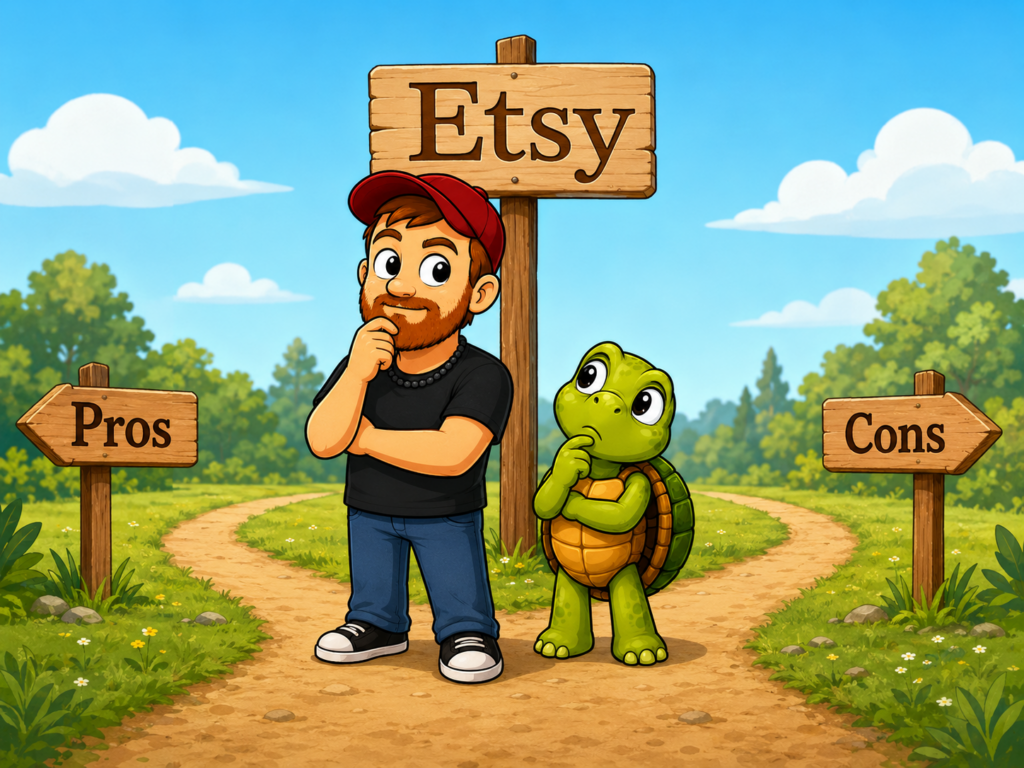
The Pros of Selling on Etsy
Etsy Gives You Access to an Existing Marketplace
One of the biggest advantages of selling on Etsy is that you are not starting with an empty website and trying to find every shopper yourself. As of December 31, 2025 according to Etsy’s 2025 annual report, the Etsy marketplace had:
- 86.5 million active buyers
- 5.6 million active sellers
- Approximately $10.5 billion in annual gross merchandise sales
Etsy also reported approximately $790.9 million in advertising expenses related to direct marketing during 2025, helping bring shoppers into its marketplaces. This means Etsy already has millions of shoppers searching for handmade, personalized, vintage, unique, and digital products. That creates a wide variety of opportunities, not only in the products you can offer, but also in the types of customers you can target.
However, does Etsy bring sellers traffic automatically? Not necessarily. Etsy brings millions of shoppers to the marketplace, but that does not mean every seller or listing will receive views. We will discuss that more in the cons section because there is a lot of misinformation surrounding Etsy marketplace traffic and what it actually means for a new shop.
Is It Easy to Sell on Etsy?
From a technical standpoint, Etsy makes it relatively easy to start selling online. You can create a shop, upload a product, and begin selling without needing much technical experience. This is a major advantage when compared with building and maintaining your own e-commerce website from scratch.
Etsy also provides tools for:
- Processing customer payments
- Managing listings and orders
- Communicating with buyers
- Purchasing shipping labels in supported locations
- Collecting and remitting marketplace sales tax where required
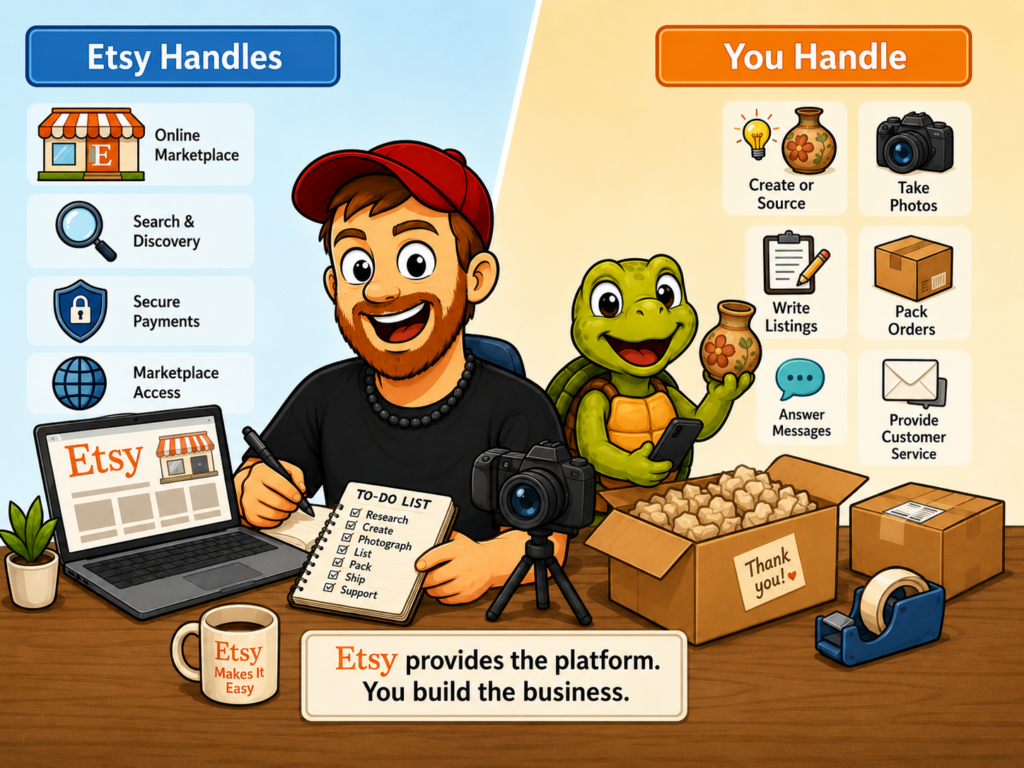
Etsy provides the marketplace infrastructure, including the storefront system, search tools, payment processing, and access to an existing customer base. However, it does not run the business for you. Sellers are still responsible for creating or sourcing their products, taking product photos, writing titles and descriptions, setting prices, managing inventory, shipping orders, answering customer questions, and resolving any issues that come up after a sale.
I will also be creating a beginner walkthrough showing how to start selling on Etsy, so be sure to keep an eye out for that.
Buyers Already Know and Trust Etsy
This built-in customer trust is one of the biggest benefits of selling on Etsy, especially for new sellers who have not yet established their own reputation. When you first begin selling on Etsy, shoppers may be more willing to trust your shop than they would a completely unfamiliar independent website. You still need good reviews, professional product photos, clear policies, and helpful customer service to show that your individual shop is trustworthy. However, you also receive some of the benefits of selling through a marketplace that buyers already recognize.
Etsy’s Purchase Protection program and established dispute process can make shoppers feel more comfortable ordering from a seller they have never purchased from before. That’s a definite plus in your favor if you are brand new to selling online.
With your own website, you are a complete unknown at first. You must build social proof, earn reviews, and establish a reputation for being trustworthy from the ground up. Naturally, that takes time and sales. For sellers who need an established marketplace and do not yet have a loyal audience of their own, this is one reason selling on Etsy can be a good idea.
What Does It Cost to Sell on Etsy?
Etsy is relatively inexpensive to start compared with many independent e-commerce platforms. Etsy will charge new sellers a one-time, nonrefundable shop setup fee. Etsy does not publish one fixed amount because the fee can vary by location and other factors, but sellers commonly report being charged between $15 and $29 USD. The exact amount is displayed during the shop setup process before payment.
Etsy does not require sellers to maintain a monthly subscription for a basic shop. Sellers can choose Etsy Plus, which currently costs $10 per month, but it is optional and is not required to sell. Also, standard Etsy listings cost 20 cents each and generally remain active for four months unless they sell out or automatically renew.
Want 40 Free Etsy Listings?
Before opening your new Etsy shop, use my referral link to receive 40 free listing credits. I’ll receive 40 free listing credits too if you successfully open your shop through the link. That’s an $8 savings for each of us.
When you make a sale, Etsy charges a 6.5% transaction fee. Etsy Payments processing fees are charged separately and vary by country. For sellers in the United States, the payment-processing fee is typically 3% plus 25 cents per order.
Other possible costs include:
- Etsy Ads
- Offsite Ads
- Currency-conversion fees
- Listing renewal fees
- Etsy Plus
- Shipping-label costs
- Regulatory operating fees in certain countries
This makes Etsy cheaper upfront than building and maintaining many independent online stores. The important thing to remember is that Etsy may be inexpensive to start, but its per-sale fees become more noticeable as your order volume grows, which is a problem most sellers would be happy to have.
So, what does Etsy charge to sell, and does Etsy take a cut when you make a sale? The answer includes listing fees, transaction fees, and payment-processing fees.
Example: Etsy Fees on a $25 Sale
On a $25 U.S. sale with no separately charged shipping, Etsy’s basic fees would be approximately:
Transaction fee: $1.63
Payment-processing fee: $1.00
Listing fee: $0.20
Total Etsy fees: approximately $2.83
That leaves about $22.17 before subtracting the cost of the product, packaging, shipping, advertising, and other business expenses.
So, are Etsy fees worth it? That depends on whether the marketplace traffic, buyer trust, and built-in selling tools provide enough value for your business. As a beginner, I believe that they are worth it.
The Cons of Selling on Etsy
Competition on Etsy Can Be Intense
Why is selling on Etsy so hard for some sellers? One major reason is that the competition on Etsy can be intense. Creating a good product is not always enough (and honestly, that is true regardless of where you choose to sell).
You still need:
- Strong product photographs
- Searchable titles and tags
- Useful descriptions
- Competitive pricing
- A clear target audience
- Products people actually want
- A basic understanding of marketing and conversion
You may also be competing with shops that use deeply discounted products to attract clicks, high-volume sellers with lower production costs, and businesses willing to spend considerably more on advertising.
However, Etsy’s millions of active sellers are not all competing for the same customers. Your actual competition depends much more on the product category, niche, price range, style, and keywords you target. A seller offering personalized pet memorial gifts, for example, is not directly competing with every jewelry, clothing, or digital-download shop on the platform. Some categories are extremely crowded, while smaller or more specific niches may have far fewer direct competitors.
Competition is one of the biggest disadvantages of selling on Etsy, but how difficult it feels depends heavily on your category, niche, pricing, and ability to stand out.
Etsy Traffic Does Not Automatically Become Your Traffic
A lot of gurus and talking heads on YouTube will tell you that getting traffic on Etsy is easy. While it is true that Etsy has its own built-in marketplace traffic, that does not mean it automatically becomes your traffic.
Your products still have to compete for visibility in Etsy search, recommendations, advertisements, category pages, and other placements. New listings do not automatically receive meaningful exposure simply because they were published on Etsy.
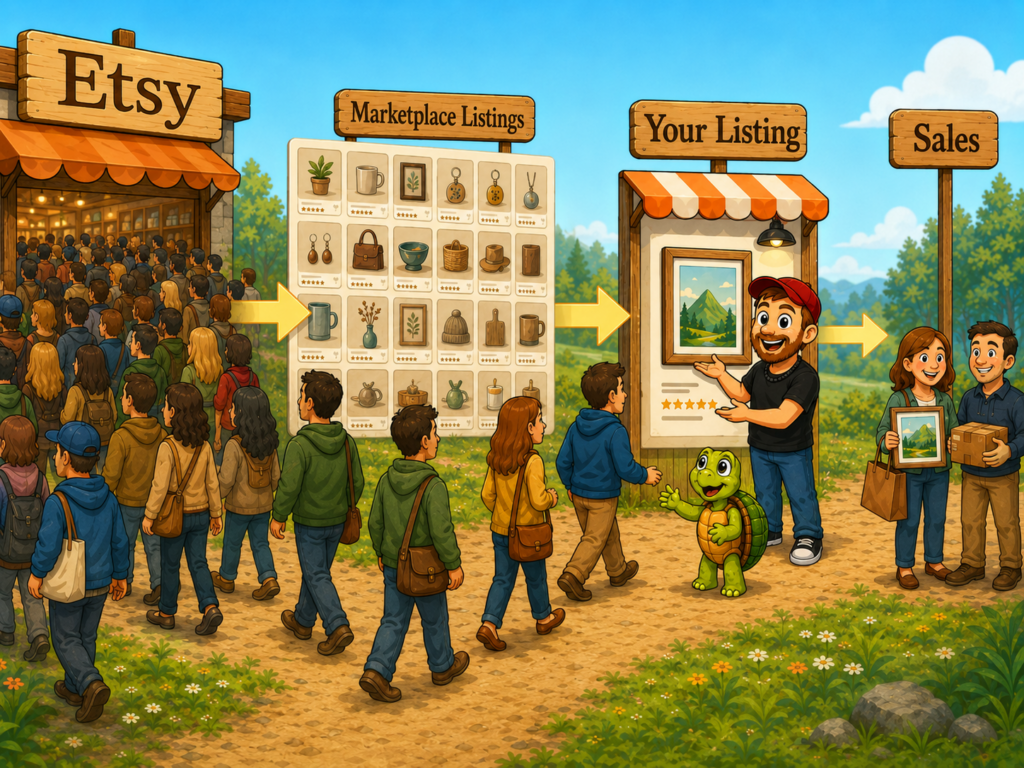
It is also important to understand the difference between impressions, visits, and sales. An impression means your listing was shown to a shopper somewhere on Etsy. A visit means someone actually clicked through to view your shop or listing. A sale means that a visit converted into a purchase. A listing can receive plenty of impressions without generating many visits, and it can receive visits without producing sales. Each stage points to a different issue. Low visits may suggest the listing is not attracting clicks, while visits without sales may indicate a problem with the product, price, photos, description, shipping, or overall offer.
Search visibility can also change as Etsy adjusts its search systems, customer experience, and marketplace features. A strategy that worked well for one seller several years ago may not produce the same results today. This is why sellers should not rely on the idea that “Etsy brings you traffic” as a complete business strategy. Etsy brings shoppers to Etsy. Your job is to create listings that attract the right shoppers and persuade them to purchase from your shop. So, does selling on Etsy work? It certainly can, but marketplace traffic alone does not guarantee visibility or sales.
Etsy Controls the Marketplace
One of the biggest cons of selling on Etsy is that Etsy controls the marketplace. For many sellers, that lack of control is also one of the clearest answers to the question, “What is the downside of Etsy?” Its rules, fees, search visibility, advertising programs, shop features, and listing displays can change. Sellers have limited control over those decisions.
Etsy also tests features and layouts that can affect how listings and shops appear. Sometimes those tests are temporary. Other times, they become permanent, and sellers may receive little warning (if any warning at all).
For example, a change in how Etsy crops or displays listing images can affect photographs that were designed around a previously recommended image ratio. Sellers may then have to update all of their listing images to prevent important parts of their products from being cropped. I have seen this happen where no notice was ever given to sellers, and if not for the community I am in, I might not have known at all! This can be extremely frustrating, especially when your income depends heavily on one marketplace.
Etsy Fees Can Become Expensive as You Grow
Although Etsy can be inexpensive to start, the cost structure may feel less attractive once your sales volume increases. As mentioned earlier, each order can include transaction fees, payment-processing fees, listing renewals, advertising costs, and possibly Offsite Ads fees. Sellers must account for those expenses when setting their prices.
Sellers sometimes ask, “Why is Etsy so expensive?” Usually, it is not one single charge causing the problem, but several Etsy seller fees stacking together on each order. This does not automatically mean Etsy fees are unreasonable. Etsy provides access to its marketplace, payment infrastructure, buyer trust, and seller tools. The important question is whether the value Etsy provides is worth the fees for your particular business.
So, are Etsy fees worth it? For some sellers, yes. For others, especially those with thin profit margins or high advertising costs, the fees may become difficult to absorb as the business grows. We will cover this in more detail in a separate post, including how the fees compare with the traffic, tools, and buyer access Etsy provides.
You Are Building on Rented Land
When you sell only through Etsy, your business depends on a platform you do not own. You do not control Etsy’s search system, marketplace rules, customer interface, or the way shoppers discover your products. Etsy also controls much of the customer relationship, which can make it harder to build an independent audience and encourage buyers to follow your business beyond the marketplace.
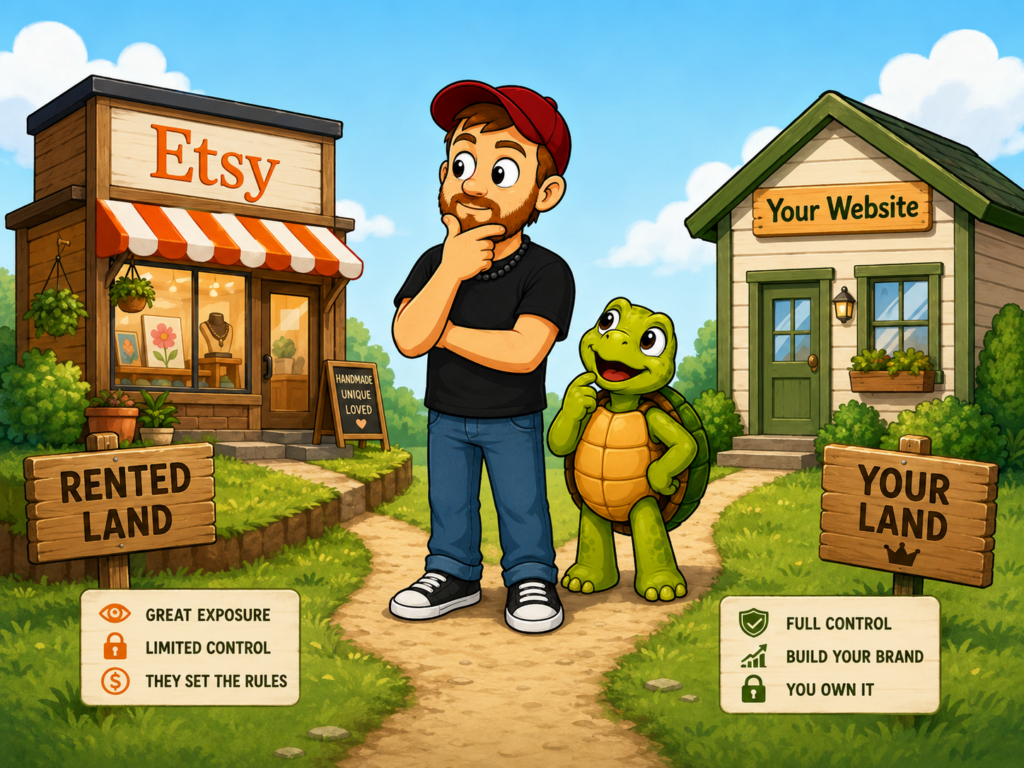
When comparing selling on Etsy vs. your own website, the biggest difference is control. Etsy gives you access to an established marketplace, while your own website gives you greater control over your branding, customer relationships, and long-term audience.
That does not mean you should avoid Etsy. It means you should be careful about making Etsy the only place where customers can find you. Building an audience through social media, Pinterest, an email list, or your own website gives your business other ways to reach customers if your Etsy traffic changes.
Etsy Can Be a Starting Point, Not the Final Destination
Etsy can be a valuable place to begin learning how online business works. It gives new sellers an opportunity to see how customers respond to their products, which designs attract attention, how listing photos affect buying decisions, and what it takes to fulfill orders and manage customer expectations. As a beginner, those are useful skills that can travel with you well beyond Etsy.
However, sellers are still operating inside Etsy’s ecosystem. A customer may remember that they purchased something from Etsy without remembering the name of the individual shop that created it. That can make it difficult to build a recognizable independent brand when the business relies entirely on the marketplace. Etsy can remain an important sales channel, and in my opinion, a great foundation where beginners can learn how to sell online. Use what you learn there to begin creating other ways for customers to discover and remember your business.
Over time, that could include:
- Social media
- An email list
- Your own website
- Additional marketplaces
- Affiliate relationships
- Creator partnerships
- More direct relationships with your customers
Your business becomes more secure when customers recognize your brand instead of only recognizing the platform where they found you. Etsy may be where the business begins, but it does not have to be the only place where it can grow.
Is Etsy Still Profitable?
So, does selling on Etsy make money? It can, but sales revenue alone does not tell you whether the shop is actually profitable. Profitability depends on much more than the number of orders you receive.
You must account for:
- Product or production costs
- Packaging
- Shipping expenses
- Etsy fees
- Advertising
- Returns and replacements
- Your time and labor
- Income and business taxes
A shop can generate strong sales revenue and still earn very little profit if its prices are too low or its expenses are too high. Protecting your margin is crucial.
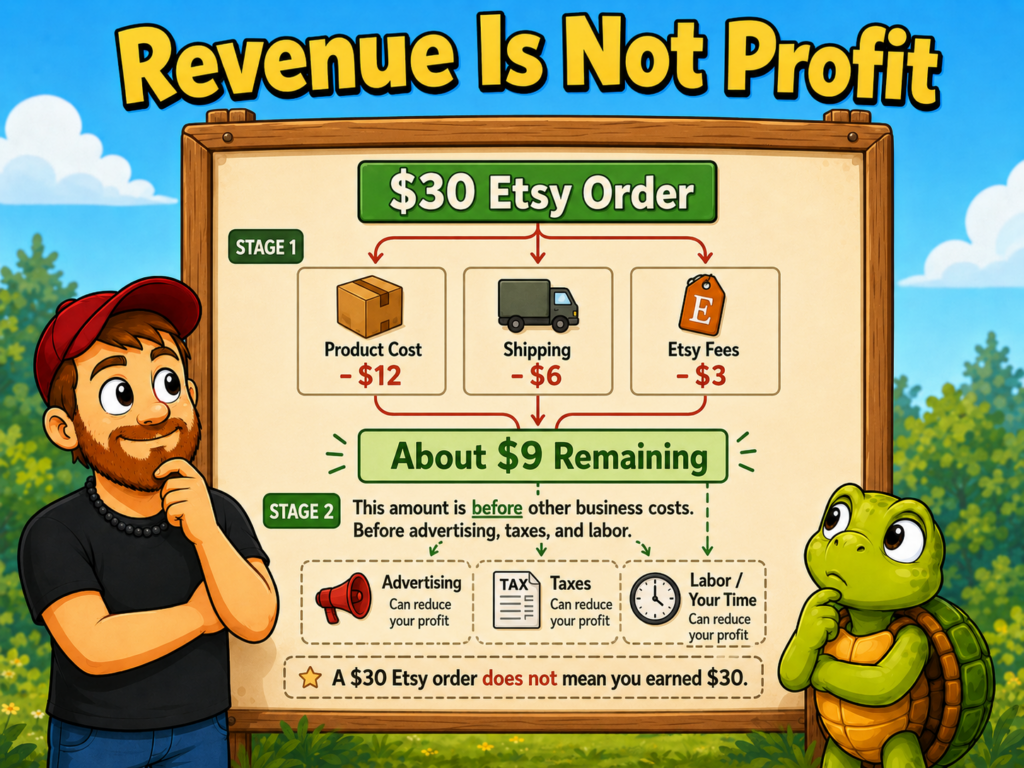
Revenue and profit are not the same thing. For example, a $30 Etsy order does not mean the seller earned $30. After subtracting Etsy fees, product costs, packaging, shipping, advertising, and labor, the actual profit may be much smaller. If the seller spends $12 producing the item, $6 shipping it, and approximately $3 in Etsy fees, only about $9 remains before advertising, taxes, and the value of the seller’s time are considered.
So, can selling on Etsy be profitable? Yes, but only when sellers price their products high enough to cover all expenses and still leave a worthwhile profit margin. The best way to determine whether selling on Etsy is profitable for you is to calculate the complete cost of each product before deciding on a selling price.
Who Is Etsy Best For?
So, is selling on Etsy a good idea? It can be, especially for sellers whose products fit the marketplace and who want a relatively simple way to begin selling online. Etsy can also be good for new sellers because it provides an established platform, built-in tools, and access to shoppers without requiring them to build a full e-commerce website first.

Etsy may be a good place to start for sellers who:
- Want a relatively simple way to begin selling online
- Sell handmade, designed, personalized, vintage, craft-supply, or digital products that fit Etsy’s marketplace
- Do not want to build an independent website immediately
- Are willing to learn product photography, Etsy SEO, pricing, and marketing
- Understand that sales and traffic are not automatic
- Want to test products before investing in a larger e-commerce setup
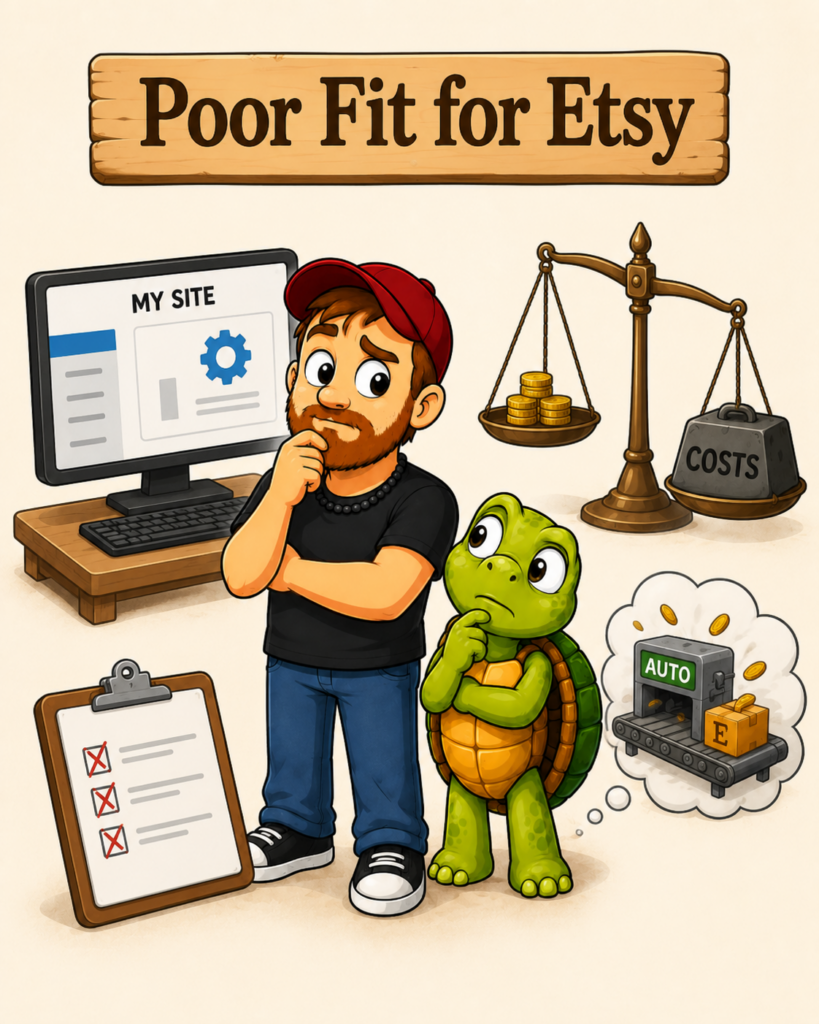
Etsy may be a poor fit for sellers who:
- Want complete control over their website and customer experience
- Have extremely small profit margins
- Do not want to follow marketplace rules
- Expect Etsy to generate sales without additional work
- Are building products that do not fit Etsy’s marketplace or policies
- Want full ownership of their customer relationships
Ultimately, who should sell on Etsy depends on the product, profit margins, business goals, and willingness to work within Etsy’s rules. It is often a strong starting point, but it is not the best long-term fit for every business.
Is Selling on Etsy Worth It in 2026?
For many new sellers, Etsy can still be worth it. It provides a relatively simple way to begin selling online, access to an established marketplace, and tools that would otherwise require sellers to build and manage themselves.
However, Etsy works best when you approach it with realistic expectations. Traffic and sales are not automatic; fees must be included in your pricing, and your business should not depend entirely on one marketplace.
For sellers with products that fit Etsy, sufficient profit margins, and a willingness to learn product photography, search optimization, and marketing, Etsy can be a valuable place to begin. It may not be the right long-term home for every business, but it can be an effective place to test products, understand customers, and build skills that can be used elsewhere. As the business grows, sellers can also begin exploring other ways to reach potential customers, including Pinterest marketing, social media, email, and their own website.
Want 40 Free Etsy Listings?
New Etsy sellers may be eligible to receive 40 free listing credits by opening their shop through my referral link. I receive 40 free listing credits as well when an eligible seller successfully opens a shop and publishes listings through the link. At Etsy’s standard 20-cent listing fee, that represents an $8 value for each of us.

Important: Use the referral link before opening your shop or beginning Etsy’s shop-setup process. The referral credits do not apply if you have already begun setting up the shop.
Want Help Building Your Etsy Business?
Opening an Etsy shop is the easy part. Choosing products, researching keywords, creating listings, understanding traffic, and avoiding the mistakes so many other sellers make can be much harder. George McConnell’s e365 Academy provides over 50 hours of step-by-step training, practical resources, and a supportive community with over 3000 members where Etsy and e-commerce sellers can ask questions and get help as they build.
Affiliate disclosure: If you sign up for e365 Academy through my link, I may earn a commission at no extra cost to you.