
Having the right business owner mindset is crucial for small business owners and entrepreneurs. Starting a business on Etsy or any e-commerce platform changes more than where your paycheck comes from. It changes who is responsible for deciding what needs to be done, when it needs to be done, whether it actually gets finished, and most importantly, what happens when it doesn’t.
When you’re an employee, much of that structure already exists. There are schedules, deadlines, expectations, managers, meetings, and usually somebody who notices when Tuesday’s project quietly becomes Friday’s project. We’ve all been employees at some point, and most bosses held us accountable for our job responsibilities, regardless of whether we wanted to punch them in the face or not, lol. But when you own the business? You can move Tuesday’s project to Friday, Friday’s project to next Wednesday, spend six hours researching a new idea instead, and technically nobody can stop you. Congratulations. You’re the boss!
Why the Right Business Owner Mindset Matters
That freedom is one of the best parts of entrepreneurship. It’s also one of the reasons developing the right business owner mindset matters so much. A business owner mindset isn’t about pretending everything is wonderful, repeating positive affirmations, or convincing yourself that wanting something badly enough will make it happen. Those things don’t produce results, especially when it’s all on your shoulders.
It’s about how you think, decide, and act when the responsibility is yours. It also means learning to recognize the thought patterns and habits that keep pulling you away from the outcome you want, then deliberately training yourself to respond in ways that move you toward it. And sometimes the biggest challenge isn’t figuring out what to do. It’s getting yourself to actually do what you already know.
What Is a Business Owner Mindset?
A business owner mindset is the way an entrepreneur trains their thoughts, decisions, habits, and actions to support the outcome they are trying to create. That includes making decisions without perfect information, learning from results, adjusting when something isn’t working, and taking responsibility for the things within your control. But it also means paying attention to the patterns behind those decisions.
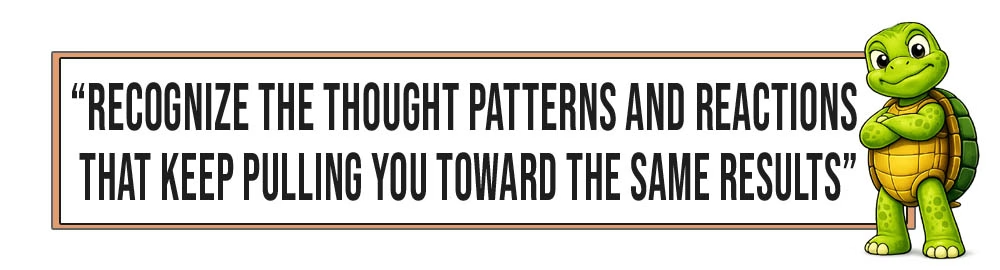
If your default response is always this probably won’t work, I’m not ready yet, or I need more information first, those thoughts will influence what you do next, even when you don’t want them to. The goal isn’t simply to eliminate every negative thought. Thinking everything will be sunshine and rainbows is nice, but not realistic. The goal is to recognize the thought patterns and reactions that keep pulling you toward the same results, then deliberately practice responses that better support where you want your business to go.
The Right Business Owner Mindset Requires Stacking Proof
The research into what academics call entrepreneurial self-efficacy (essentially an entrepreneur’s belief in their ability to handle the tasks and roles involved in running a business) has been studied for decades in areas including marketing, innovation, management, risk-taking, and financial control.
That belief can grow through experience. The process follows a very simple flow every business owner should embrace. You make a decision. You take action. Then you analyze the results of that action. From there, either you build on what worked, or you pivot and adjust based on what didn’t. Then the flow starts all over again.
Each time you follow through and handle the result, you create more evidence that you can move forward. Those small wins begin to stack into proof. Consider them receipts for the work you’ve put in and remember them. The more receipts you stack, the more evidence you create that you can handle the next decision, the next challenge, and the next step forward.
Mindset for Entrepreneurs Requires Asking Questions
You don’t need the academic terminology of entrepreneurial self-efficacy to see it in everyday business ownership, though. You see it every time a business owner has to make a decision. That’s where mindset stops being an abstract idea and starts affecting actual business decisions.
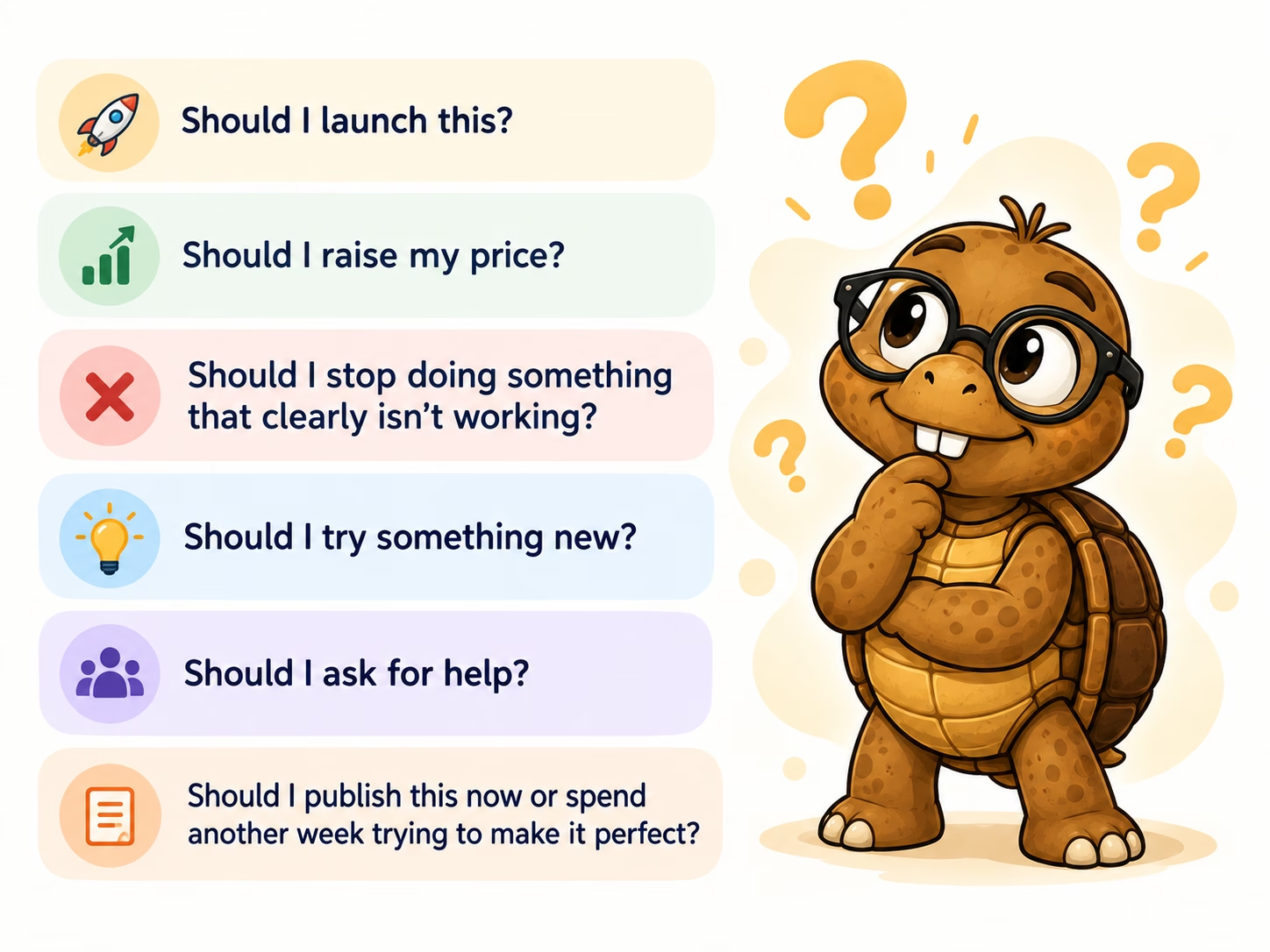
Those questions are unavoidable. What matters is the pattern behind the way you answer them. A stronger mindset for entrepreneurs means learning to recognize when fear, perfectionism, old habits, or doubt are making the decision for you, then choosing the response that better supports the outcome you want. And at some point, that decision has to turn into action.
Knowing What to Do Isn’t the Same as Doing It
Most entrepreneurs today don’t suffer from a complete lack of information. Quite the opposite. You can find a tutorial for almost anything. There are YouTube videos, podcasts, courses, blogs, communities, AI tools, social posts, and enough expert advice to keep you researching until approximately the year 2047. And don’t get me started on shiny object syndrome with all the useful tools out there that can supposedly help your e-commerce business.
Information is useful. Research is useful. Learning is useful. But there comes a point when learning stops preparing you to act and starts giving you a very respectable-looking reason not to.
A Tale of Two Turtles- Sheldon Researches
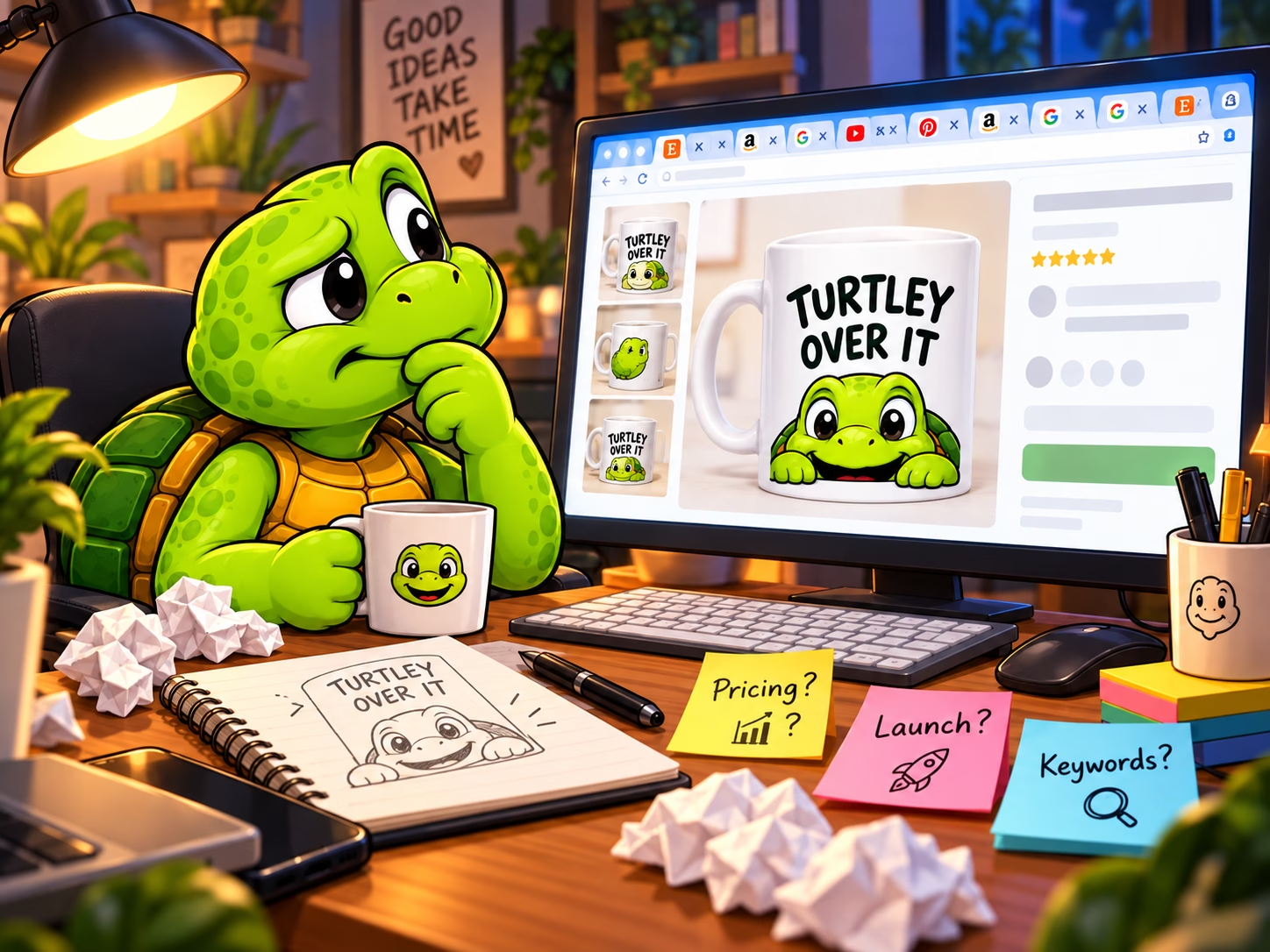
Imagine Sheldon wants to launch a new “Turtley Over It” coffee mug featuring a thoroughly exhausted turtle clutching a cup of coffee and looking like Monday has already won. Sheldon starts by researching the market. He studies competing turtle mugs, compares prices, and analyzes keywords. Then he watches five videos about product photography because apparently the turtle’s expression may not communicate the appropriate level of emotional defeat without the proper lighting.
Next, Sheldon wonders whether listing on Thursday might convert better than Wednesday and spends two hours asking ChatGPT. During that research, he discovers that the right day may not be enough. The right time could matter too. So Sheldon studies ideal posting times, compares time zones, and tries to determine the perfect moment to launch his mug. By the end of the day, Sheldon feels pretty accomplished. He learned a lot. Maybe tomorrow he can research which font best communicates being turtley over it.
A Tale of Two Turtles- Tater Tot Moves
Meanwhile, Tater Tot creates a reasonable version of the same mug, lists it on Etsy, and moves on. Tater’s plan is simple: put the product in front of actual buyers, watch what happens, and learn from the results. His first order comes in. The customer likes the design but thought the artwork would appear on both sides of the mug. Tater updates the listing photos. A few days later, another customer asks whether the design comes on a 15 oz mug. Tater adds that option. Then another buyer leaves a 5-star review saying the turtle design made her laugh because she had been “turtley over it” all week.
Now Tater knows several things he didn’t know before he launched. Buyers understand the joke. They care about seeing both sides of the mug. At least one buyer wants another size. And most importantly, someone actually paid for the product.

So who is developing the stronger business owner mindset? Tater may eventually discover that the idea needs work. He may change the photos, the price, the design, or even decide the product isn’t worth continuing. But now he has something important Sheldon doesn’t have. He has real evidence. Sheldon is still trying to predict what buyers might do and has no “receipts” to show for his efforts. Tater gave buyers something to respond to, and every response gives him another chance to learn, adjust, and stack another win.
Don’t Allow Busy Work to Replace Real Work
That doesn’t mean research is bad or that every idea should go live five minutes after you think of it. Good research can prevent expensive mistakes and help you make smarter decisions. But there comes a point when action produces information that research cannot.
That distinction matters because busy work can feel incredibly productive. Sheldon isn’t sitting on the couch doing nothing. He’s researching, comparing, learning, planning, and making notes. The problem is that all of that activity can reinforce the same old mindset pattern if he continually uses it to avoid the uncomfortable next step. But Tater is training a different response. He gathers enough information to make a reasonable decision, acts on it, and lets the result teach him what to do next.
That last part is the important thing to note here. Sheldon and Tater aren’t just two productivity styles anymore. They’re training two different mental responses. Sheldon is reinforcing the idea that when he feels uncertain, he should research more. Tater is reinforcing the idea that when he has enough information, he should take the next reasonable action and learn from it. A strong mindset for entrepreneurs doesn’t mean rushing every decision. It means learning to recognize when preparation has done its job, and it’s time to move. At some point, you have to be turtley over it and hit publish, lol.
A Strong Business Owner Mindset Uses Evidence to Adjust
Taking action is important, but action by itself is not the finish line. A strong business owner mindset also requires looking at what happened after you acted and deciding what the result is telling you. That sounds obvious, but business owners can get surprisingly attached to an idea, a product, a strategy, or even the amount of time they have already invested in something. Once that happens, it becomes easy to treat changing course like failure. It isn’t.
Sometimes the evidence tells you to keep going. Other times it tells you to make a small adjustment. Sometimes it tells you that the thing you were convinced would work simply isn’t producing the outcome you wanted. That’s still useful information.
Make Informed Decisions to Move Closer to Your Goals

The goal is not to prove that every decision you make was right. It’s to get better at making the next decision based on what you learn. Tater’s mug example shows how this works. He launched the product, buyers responded, and each response gave him something new to work with. One customer showed him that his listing photos were unclear. Another revealed demand for a larger mug. A positive review gave him proof that the joke connected with the right buyer. None of those things were available to him before he acted.
That’s why learning to separate the result from your ego matters. A weak result doesn’t automatically mean I’m bad at this. It may simply mean the price is wrong, the offer needs work, the audience is different than you expected, or the idea is not worth pursuing. The most successful people learn to pivot and adapt. Failures are just proof of forward movement. How you handle those failures determines how much further you can go.
Ask What Is This Result Showing Me, and What Should I Do Next
That might mean improving the product, changing the marketing, adjusting the price, trying a different platform, or deciding to stop putting energy into something that is no longer moving you toward the outcome you want.
For example, Etsy sellers eventually have to look beyond “everyone says Etsy is a good place to sell” and decide whether the platform actually makes sense for their products, margins, and goals. I wrote more about that in my article on whether selling on Etsy is worth it.
Changing course doesn’t erase the work you already did. It means you’re using the evidence that work created. That’s part of the right business owner mindset too: act, observe, adjust, and keep moving toward the outcome you’re actually trying to build.
Why Accountability Matters for Business Owners
One of the biggest changes that comes with owning a business is losing some of the external structure that used to keep you moving. When you’re an employee, deadlines, managers, meetings, performance expectations, and coworkers often create built-in accountability. Someone usually notices when something doesn’t get done.
Business ownership gives you much more freedom. It also gives you much more room to quietly renegotiate your own commitments, lol. A customer deadline feels real. Your own deadline can suddenly become surprisingly flexible. That matters because building a stronger business owner mindset is not just about knowing what you should do. It also requires creating enough structure around yourself to keep following through when the easier option is to delay, avoid, or change the plan.
Self-Accountability Has Limits

You can always create systems. Calendars help. Task lists can help you stay on task. Deadlines can push you. Habit trackers help. My personal favorite is writing something on a list so I can experience the deeply satisfying thrill of crossing it off later. But every one of those systems shares the same weakness. You are still the only person enforcing it, lol.
If you decide not to do something, your calendar probably isn’t coming to find you. Google Calendar has yet to kick down anyone’s door, to my knowledge. I’d like to see him try it, though, lol.
That doesn’t make self-accountability useless. It just means you need to recognize where your own patterns tend to show up. If you constantly move private deadlines, avoid uncomfortable tasks, or let easier work replace the thing that actually matters, then the system itself may not be enough. That’s where outside accountability can become valuable.
Accountability Helps Reinforce the Mindset You’re Building
The moment you tell another person, a mentor, or a community what you intend to do, the commitment becomes harder to quietly rewrite. They may ask how it went. Someone may notice that you keep avoiding the same step. They may point out a pattern you can’t see because you’re standing in the middle of it. And sometimes someone simply asking, “You’ve been talking about this for three weeks. What are you actually going to do next?” is more useful than another 45-minute tutorial.
That kind of accountability does more than keep a task on schedule. It helps reinforce the mindset patterns and actions you’re trying to train. If your old response to uncertainty is to delay, research more, or move the deadline, accountability creates a reason to interrupt that pattern and choose a different response. That’s one reason outside support can matter so much for entrepreneurs.
SCORE, a nonprofit resource partner of the U.S. Small Business Administration, specifically describes ongoing mentoring as a way to add accountability to an entrepreneur’s desired progress and pace. The SBA also maintains a network of business counseling and mentoring resources, including SCORE mentors and Small Business Development Centers, for entrepreneurs who need guidance and support while starting or growing a business.
You don’t need someone else to run your business for you. But sometimes having another person know what you said you wanted is enough to make it harder to quietly walk away from it.
Your Environment Can Shape Your Business Owner Mindset

The people you spend time around can also influence the way you think about your business. If you constantly surround yourself with people who dismiss every idea, expect the worst, complain about everything, or treat every setback like proof that something is impossible, that attitude can start to affect the way you respond, too. Over time, those attitudes can begin influencing how you think about your own business and the challenges you face.
The opposite can also happen. Spending time around other business owners who are working toward goals, testing ideas, learning from mistakes, and continuing to move forward can make those behaviors feel more normal. That doesn’t mean you need a room full of people who agree with everything you say. In fact, that probably wouldn’t help much at all, lol. The value comes from surrounding yourself with like-minded people who are working toward similar goals, trying to grow, and willing to challenge your thinking without tearing it down.
A stronger mindset for entrepreneurs becomes easier to reinforce when the environment around you supports the habits, standards, and outcomes you’re trying to create. If everyone around you constantly reinforces the old pattern, changing it becomes harder. But if the people around you encourage action, reflection, growth, and accountability, they can help reinforce the new one. That’s one reason the people you choose to learn from, work beside, and spend time around can matter just as much as the information you consume.
Community Can Show You What You Can’t See Yourself
Information can teach you how to do something, but community can help you see how you are approaching it. That difference matters because business owners are often too close to their own decisions to see the patterns behind them. You can research how to raise your prices. A community may help you realize that you already know how to change them, but you’re just afraid customers might leave. You can easily learn how to launch a product. But other business owners may notice that you’ve redesigned the graphics six times because launching means somebody can finally judge the thing. You can research marketing strategies all day, but eventually, somebody may ask the uncomfortable question you avoided. Which one have you actually tried?

That kind of outside perspective can reveal blind spots, excuses, and patterns that are hard to recognize when you’re standing in the middle of them. It can also show you possibilities you may not have considered on your own.
Someone with similar goals may have already tested the idea you’re stuck on. Another person may recognize a problem they struggled with six months ago. Sometimes hearing how someone else handled a similar challenge is enough to help you look at your own situation differently. Seeing someone else have success can inspire you.
For many entrepreneurs, surrounding yourself with like-minded people creates more than motivation. It gives you a place to compare experiences, challenge assumptions, learn from other people’s wins and mistakes, and keep your own thinking from becoming an echo chamber. That can play a big role in building a stronger business owner mindset because growth is not always about learning something new. Sometimes it’s about finally seeing something you’ve been missing. Those discoveries and perspectives can’t be manufactured individually.
Where Magnetic Mindset Fits
Everything we’ve talked about so far comes back to one idea. To have the right business owner mindset, changing your results usually requires more than knowing what to do. You have to recognize the thoughts and patterns that keep pulling you toward the same outcomes, practice different responses, take action, stack proof, learn from the results, and keep moving. That’s where Magnetic Mindset fits for me.
I’m part of the Magnetic Mindset community, and what I value about it isn’t simply being told to “think positive” or believe hard enough that everything will work out. There is actual work involved. You identify where you want to go, pay attention to the thought patterns and behaviors that may be working against that outcome, and deliberately start building different ones. Then you act. And over time, those actions begin creating the receipts that show you whether you’re actually becoming the person capable of building what you said you wanted.
Magnetic Mindset Helps Turn Intention Into Proof
One of the principles I’ve taken from Magnetic is that you can’t build a stronger mindset on intention alone. To build a stronger business owner mindset, you need motivation and evidence. That might mean following through on something you normally avoid, making the decision you’ve been putting off, trying something new, or simply keeping a commitment you made to yourself. Each win becomes another receipt.
Not every receipt means everything worked perfectly. Sometimes the proof is that you tried something, it failed, and you handled it. Sometimes it’s realizing you can change direction without treating that decision like a personal failure. The point is to keep giving yourself evidence that you can think differently, respond differently, and continue moving toward the outcome you want.
The Community Reinforces the Work

The community side plays a huge role in this, and is quite possibly the one thing that makes everything in Magnetic work. Members are working toward their own goals, but they are surrounded by other people who are also trying to grow, challenge old patterns, and make progress. There are Magnetic Monday sessions, regular hot seats, community discussions, and Friday Receipts, where members look at what actually happened rather than only what they intended to do. Members also work on things like their North Star (getting clear about the outcome they are trying to create) and identifying the patterns that may keep pulling them away from it.
That combination matters because changing your mindset isn’t always something you can accomplish entirely on your own. Other people can celebrate your wins, challenge your thinking, point out blind spots, and sometimes recognize when your actions no longer match the goals you’ve set for yourself. As a member myself, it’s great just being surrounded by like-minded individuals who are all pushing toward similar goals. Having peers who celebrate your wins, challenge your thinking, and support your progress can make the journey feel a lot less lonely.
Want to Learn More About Magnetic Mindset?
Magnetic Mindset doesn’t replace learning how to market, price, create, sell, or operate a business. It focuses on a different part of the equation: the person making all those decisions. And when you own the business, that person matters quite a bit.
That’s one of the reasons I’ve found being part of Magnetic Mindset valuable. It’s not about pretending challenges don’t exist or that changing your mindset will magically solve every problem. It’s about doing the work, recognizing what’s holding you back, and surrounding yourself with people who are committed to doing the same.
And it’s not just a supportive community. Magnetic Mindset also includes a structured, work-at-your-own-pace course. It’s designed to help members examine their thinking, challenge limiting patterns, and start making meaningful changes. The course provides a foundation for the work, while the community, live sessions, and accountability help members put those lessons into practice.

Affiliate disclosure: If you sign up for Magnetic through my link, I may earn a commission at no extra cost to you.
If any of what I’ve shared in this article sounds familiar, and you’re curious about the course and community I’ve been talking about, I encourage you to take a look at Magnetic Mindset and see whether it might be a good fit for you. It has taken my business owner mindset to the next level, and I’m just getting started!
FAQs About Business Owner Mindset
What is a business owner mindset?
A business owner mindset is the way an entrepreneur approaches responsibility, decisions, uncertainty, setbacks, and action when they are responsible for the outcome of the business. It includes taking ownership of decisions, learning from results, adapting when necessary, and creating systems that support consistent follow-through.
Why is mindset important for entrepreneurs?
Entrepreneurs regularly make decisions without complete certainty. Mindset can influence whether they take action, respond constructively to setbacks, adapt to new information and follow through on plans. Good strategy is still essential, but strategy only produces results when it is implemented.
What is the difference between an employee mindset and a business owner mindset?
The biggest practical difference is often responsibility and structure. Employees usually work within systems that provide deadlines, supervision and external accountability. Business owners have much more freedom but must create many of those structures themselves. Neither mindset makes someone inherently better than the other; the roles simply require different forms of responsibility.
What are examples of a strong business owner mindset?
Examples include testing an idea instead of waiting indefinitely for perfection, evaluating results objectively, adjusting when something isn’t working, asking for help when needed, accepting responsibility for decisions and following through on commitments even when nobody else is enforcing the deadline.
Can you develop a business owner mindset?
Yes. Business mindset is not simply something you either have or don’t have. Business owners can improve the way they make decisions and respond to challenges through experience, reflection, education, feedback, mentoring, community and intentional accountability.
Why is accountability important for business owners?
Business owners often lack the built-in supervision and deadlines that come with traditional employment. External accountability from mentors, peers or a business community can help turn private intentions into visible commitments and make it harder to continually move your own deadlines.
Is mindset more important than business strategy?
They serve different purposes. Strategy helps determine what actions make sense for the business. Mindset affects how the owner approaches those actions, decisions, and outcomes. A “positive” mindset cannot compensate for a bad strategy, but a good strategy also accomplishes very little if it is never implemented with the right business mindset.
