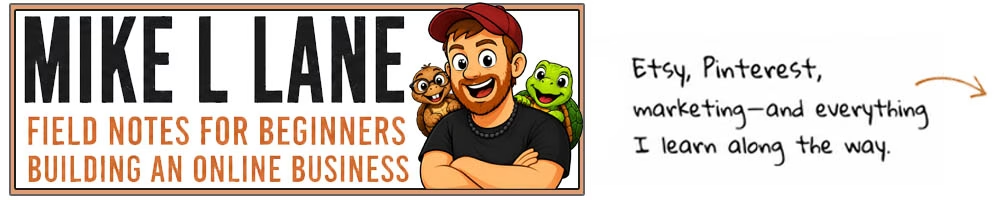

Earlier today, I received an email inviting me to create my first ChatGPT ad. My first thought was that ChatGPT advertising was further along than I realized. I’ve heard for some time that this would eventually be a thing, but I figured we wouldn’t see it until closer to Q4 or even 2027. So, I was surprised to see an invitation for ChatGPT ads for small businesses in my inbox today.
My second thought was probably the same one most small-business owners have when a new advertising platform appears. Is this actually worth using, or is it just another place to spend money? So, I dropped everything else I had planned and decided to look into it. This article covers ChatGPT ads for small businesses. We’ll look at how they work, what they cost, and what business owners should consider before getting started. I haven’t tried them for myself yet, but if and when I do, that’ll be a different post altogether. For now, let’s walk through the basics.
ChatGPT Ads Are Still in Beta
ChatGPT ads are still brand-spanking new, and OpenAI describes its self-service advertising platform as a beta product. That means features, pricing, availability, and results could all change as the system develops. The basic advertising tools are already available to businesses in the United States and several other countries. However, the platform is still evolving.
Beta Notice: This article reflects the information available on July 28, 2026. Because ChatGPT Ads is still in beta, some details may change.
What Are ChatGPT Ads?
ChatGPT ads for small businesses are paid advertisements that can appear below a relevant response in ChatGPT. ChatGPT displays them separately from the answer and clearly labels them as advertising.
So, let’s say someone asks, “Where can I buy a turtle garden statue online?” ChatGPT would respond to the query as usual. It would typically include a small selection of organic product results. Then it would explain why it selected those products. It may also offer additional information about price ranges or features, such as turtle statues with solar lights. At the bottom of that response, a separately labeled sponsored ad may also appear. The screenshot below comes from the actual search I performed and shows both the organic product results and the paid ChatGPT ad.
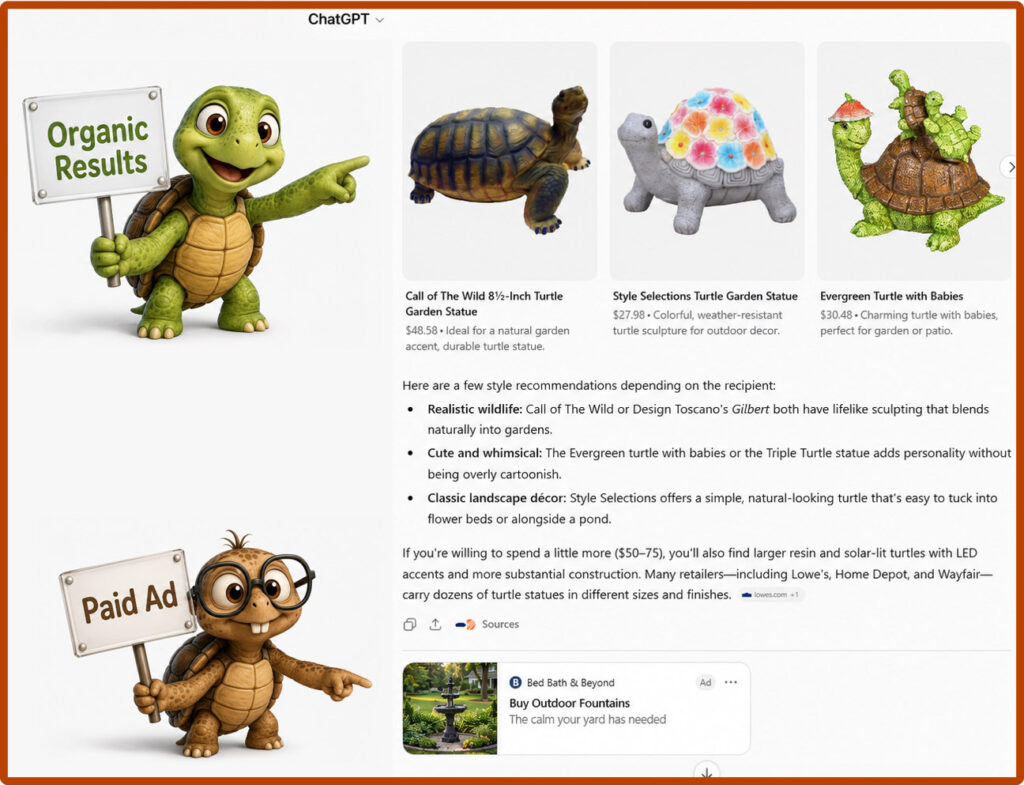
I wanted to highlight this so you could clearly see the difference between the organic product results ChatGPT includes in its answer and the paid ad below it. A business owner pays to place that ad. That distinction is important because product recommendations inside the response are not automatically advertisements. In a future post, I plan to look more closely at how businesses may appear in those organic results. Today, the focus is on the new paid ads.
What Does a ChatGPT Ad Include?
The current ChatGPT ad format can include:
- The advertiser’s name and logo
- A headline
- A description
- An image
- A link to the advertiser’s website or landing page
ChatGPT displays the ads separately from its answer and clearly labels them as sponsored content. OpenAI says advertising doesn’t influence the answers ChatGPT provides. That separation matters. A business may pay to have an ad appear near a relevant conversation, but it can’t pay ChatGPT to recommend its product inside the answer itself. Seeing an advertisement also does not mean ChatGPT or OpenAI personally endorses the advertiser.
Why Didn’t the Ad Match the Search Exactly?
As you can see in the screenshot, I asked about turtle garden statues, but the paid ad promoted an outdoor fountain. My guess is that the system didn’t have a more specific advertiser available for that conversation. Instead, it matched the broader topic of outdoor garden décor. That could create an opportunity for some businesses early on if fewer advertisers are competing for the same types of conversations. On the other hand, broader matching could also place an ad in front of people who are curious but not especially likely to buy.
Who Can See ChatGPT Ads?

ChatGPT ads may appear for users on the Free and ChatGPT Go plans. Users on Plus, Pro, Business, Enterprise, and Edu plans do not currently see ads. OpenAI also says it doesn’t show ads in accounts belonging to users under 18. This includes users who identify themselves as under 18 and users the system predicts may be under 18. Logged-out users may still see ads. It designs those ads to be appropriate for all ages because it doesn’t have age information for those users.
OpenAI also restricts ads around sensitive conversations. OpenAI says it doesn’t show them near discussions involving topics such as mental health, personal crises, politics, self-harm, regulated products, and other sensitive or potentially harmful subjects. Those restrictions may reduce the number of conversations where an ad can appear, but they also help prevent an advertisement from showing up at an inappropriate moment.
How Do ChatGPT Ads Work?
One thing I found interesting is that ChatGPT advertising isn’t built entirely around exact keywords in the way many people think of traditional search advertising. Instead, OpenAI considers several signals when deciding which ad may be relevant, including:
- The subject and intent of the current conversation
- The advertiser’s headline and description
- The content of the landing page
- Information supplied by the advertiser
- Additional personalization signals when the user allows personalized ads
Advertisers can also provide what OpenAI calls context hints. These describe the types of conversations, needs, topics, or phrases where a product may be relevant. However, context hints aren’t exact-match keywords, and adding a phrase doesn’t guarantee that an ad will appear whenever someone uses it. That makes ChatGPT ads different from simply bidding on a specific search term.
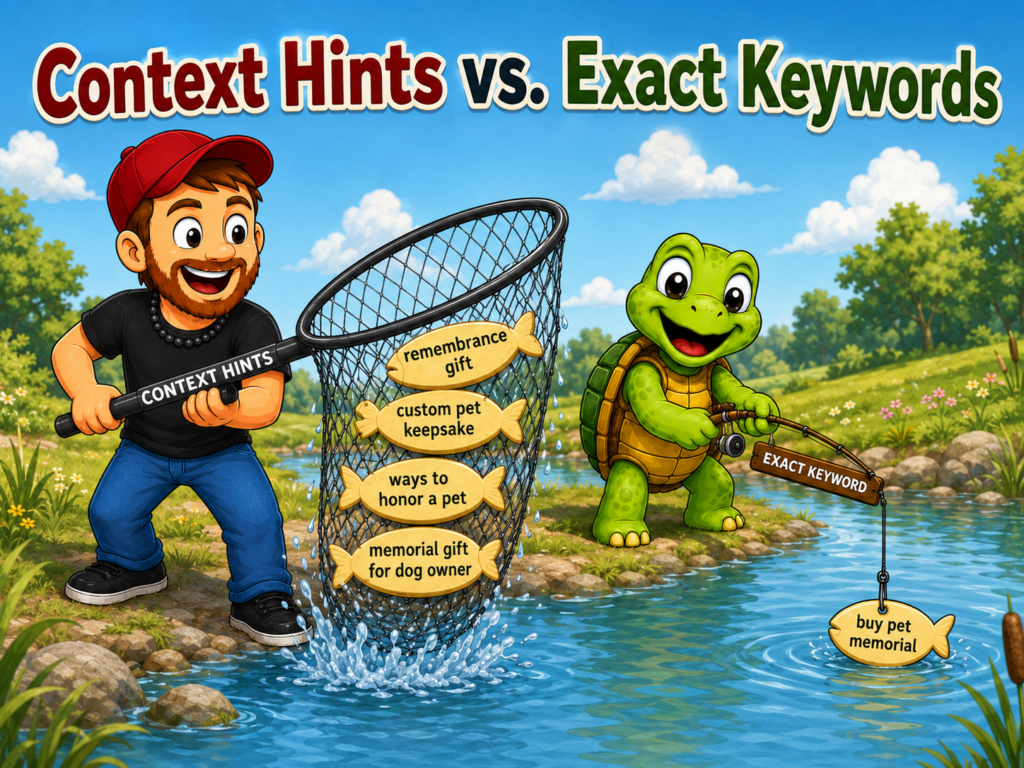
An advertiser selling personalized pet memorial products, for example, might provide context hints related to remembrance gifts, custom keepsakes, or ways to honor a pet. The system can then consider the broader intent of the conversation instead of waiting for one precise search term. At least in theory, that could help businesses reach people whose needs match the product even when they don’t use the exact words the advertiser expected. I think that could be a good thing. Instead of hunting for precise keywords to bid on, it may be more about understanding your customer and what that customer is trying to accomplish.
How to Advertise on ChatGPT
Businesses interested in testing ChatGPT ads for small businesses can create and manage campaigns through OpenAI Ads Manager Beta. Most of the steps are fairly straightforward, but I’ve broken them down to make the process as easy to follow as possible.
Create an Advertiser Account for ChatGPT Ads
You’ll enter basic business information, including your business name, website, logo, industry, country, currency, and time zone. You cannot change some settings later, particularly the country, currency, and time zone, so enter them carefully. Businesses can create more than one advertiser account, which may be useful when managing different brands, legal entities, or teams. However, each account must use a separate email address. Agencies or freelancers managing ads for multiple clients would generally use a separate advertiser account for each client so that verification, branding, billing, campaign data, and account access remain separate.
Complete Business Verification Through Persona
OpenAI currently handles business verification through Persona, a third-party identity-verification service. You’ll answer additional questions, and OpenAI may ask you to provide current identity or business documents. It’s important to understand that completing verification is not the same as receiving final account approval. After you complete that process, OpenAI also reviews the advertiser and considers whether the business offers products or services permitted under its advertising policies. OpenAI reviews applications in a rolling queue and doesn’t currently promise a specific approval time.
Add Your Billing Information
This is where you’ll create a billing profile and add a credit card. OpenAI may place a temporary $100 authorization hold on the card to verify the payment method. OpenAI releases the hold automatically, but it may remain visible for up to three days. ChatGPT Ads currently uses postpaid billing, which means charges build up after your ads begin running.
Choose a Campaign Goal for ChatGPT Ads
The campaign goal determines how OpenAI optimizes your ads and charges you. OpenAI currently offers three options:
- CPM: You pay for every 1,000 times ChatGPT shows the ad. OpenAI designed this option for reach.
- CPC: You pay each time someone clicks the ad.
- oCPC (conversion-optimized cost per click): You still pay for clicks, but the system tries to find people who are more likely to complete a selected action, such as making a purchase or signing up.
After you create a campaign, you can’t simply switch it to a different goal. If you change your mind, you’ll need to create a new campaign using the correct objective.
Set a Budget and Bid
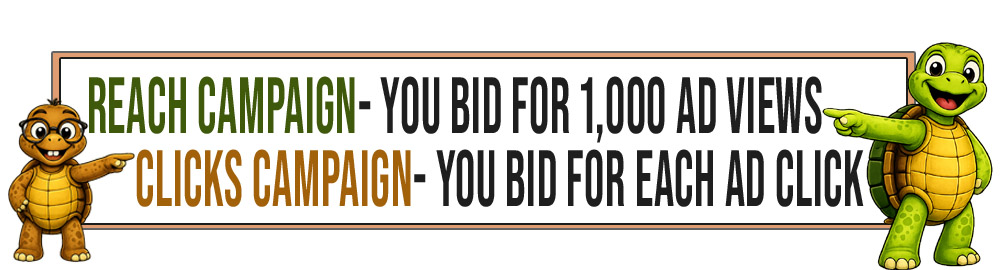
ChatGPT Ads allows you to use either a daily budget or a total budget for the entire campaign. OpenAI currently lists a minimum daily campaign budget of $25 in the United States, while minimums vary in other supported countries. A total campaign budget limits how much you can spend overall, while OpenAI may vary the amount it spends each day as it delivers the ads. Your bid is the most you’re willing to pay for the result you want. For a Reach campaign, you set the maximum amount you’ll pay for 1,000 ad views. For a Clicks campaign, you set the maximum amount you’ll pay for one click. OpenAI currently recommends starting Clicks campaigns with a maximum bid of about $3 to $5 per click, although your actual cost may be lower depending on competition for the available ad placements.
Select Targeted Locations for ChatGPT Ads
You can target your ads by country. In the United States, OpenAI also supports certain states, designated market areas, and ZIP codes. Availability varies, so you’ll need to check the location picker inside Ads Manager to see which options apply to you and your audience.
Create Ad Groups and Context Hints
An ad group is a set of closely related ads built around the same product or customer intent. Going back to our earlier example, a retailer selling outdoor décor might create one ad group for turtle garden statues and another for outdoor fountains. That keeps the ads, images, context hints, and bidding strategy organized around a specific type of shopper.
Context hints describe the kinds of conversations, topics, or phrases where an advertiser believes its product may be relevant. They aren’t traditional exact-match search keywords, and entering a hint doesn’t guarantee that the ad will appear whenever someone uses that phrase. OpenAI also considers the conversation’s context and intent, along with the ad title, description, landing page, and other signals. Looking back at our earlier example, the system matched the broader topic of outdoor décor rather than requiring an exact turtle garden statue search.
Create Your Ad
A standard ChatGPT ad includes the advertiser’s name and logo, a headline, a description, a landing-page link, and an image.
OpenAI currently recommends:
- A headline between 16 and 24 characters, with a maximum of 50
- A description between 32 and 48 characters, with a maximum of 100
- A valid, reachable landing page
- A publicly accessible square JPG or PNG image no larger than 1200 × 1200 pixels
OpenAI recommends creating several distinct ads rather than depending on one headline and description. Each version should focus on a different benefit or use case, giving the system more opportunities to match an ad with a relevant conversation. In other words, a useful test may require more than throwing together one ad and waiting to see what happens.
The landing page must also be publicly accessible to OpenAI’s ad-review crawlers. In other words, OpenAI needs to be able to open and read the page to confirm that it works, matches the advertisement, and follows its advertising policies. Security settings, bot blockers, login walls, or a robots.txt rule that blocks OAI-AdsBot could prevent the ad from being approved. For example, if an ad promotes an outdoor fountain but the linked page is blocked by a security plugin or redirects visitors to an unrelated homepage, OpenAI may not be able to review it.
Submit Your Ad for Review
Ads must be reviewed before they can begin running. OpenAI reviews the ad’s headline, description, image, landing page, advertiser, and product category to make sure everything follows its advertising policies. An ad could be rejected for misleading claims, prohibited products, offensive content, a landing page that doesn’t match the ad, technical problems accessing the page, or creative that looks too much like ChatGPT’s own interface. OpenAI also restricts or prohibits advertising in several categories, including certain financial, medical, legal, political, gambling, alcohol, tobacco, dating, and adult products or services. Some restricted businesses may be reviewed individually and asked to provide proof of licensing.
OpenAI doesn’t currently publish a guaranteed ad-review timeline. If an ad is marked Not serving, you can hover over the status inside Ads Manager to see more information, fix the problem, and resubmit the ad for review.
What Do ChatGPT Ads Cost?
This is where small businesses need to pay close attention. For campaigns focused on clicks, OpenAI currently recommends starting with a maximum CPC bid of $3 to $5 per click. The platform uses a relevance-weighted, second-price auction, so your maximum bid isn’t necessarily what you’ll pay for every click. Still, that seems high to me. Even though $3 to $5 is only the maximum bid, the cost could be difficult to justify for inexpensive products with narrow profit margins. Before deciding whether ChatGPT ads make financial sense, you’ll need to compare your average cost per click with your conversion rate, profit per sale, and long-term customer value. Even a cost near the lower end of that range could add up quickly for a business selling inexpensive products.
A Simple ChatGPT Ads Cost Example
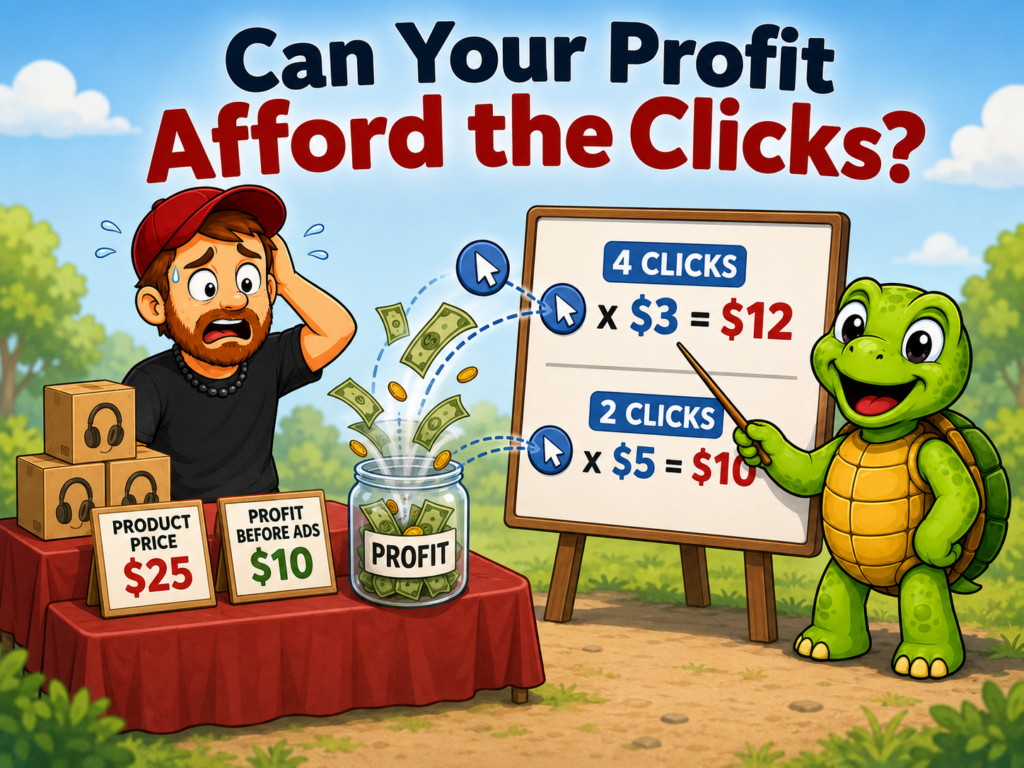
For example, suppose you sell a $25 product and earn $10 in profit before advertising:
- At $3 per click, four clicks would cost $12.
- If only one of those four visitors buys, the advertising cost has already exceeded your $10 profit.
- At $5 per click, just two clicks could use up the entire profit from one sale.
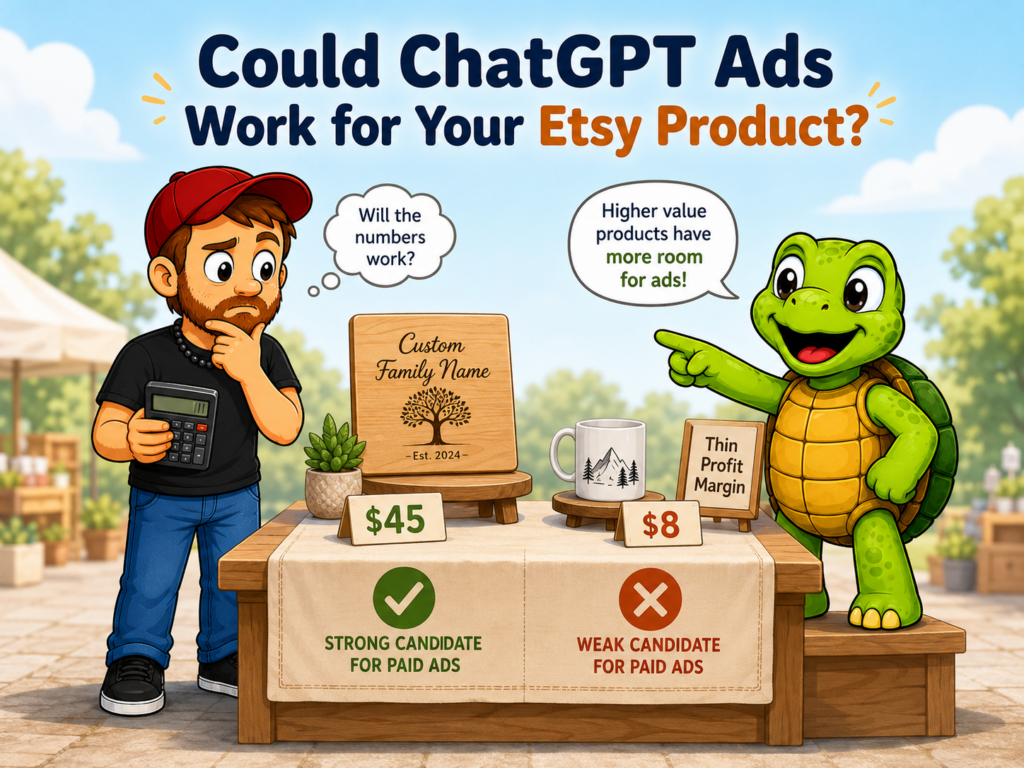
That price may be easier to justify for businesses selling expensive products, subscriptions, or services with a high customer lifetime value. A lawyer, software company, or contractor might earn hundreds or even thousands of dollars from one customer. A mug seller, gift shop, or low-priced Etsy seller would need a very strong conversion rate or plenty of repeat purchases to make clicks in the $3 to $5 range profitable.
OpenAI also currently requires a minimum daily campaign budget of $25 in the United States. You can use a daily budget or set a total budget for the entire campaign, but that daily minimum could still create a meaningful barrier for very small advertisers. At $25 per day, a one-week test could involve up to $175 in advertising spend. That isn’t outrageous compared with many advertising platforms, but it’s not pocket change for a new Etsy seller, handmade business, or solo entrepreneur.
It’s crucial to know how much profit you make from an average sale before paying several dollars for each visitor. If one sale only produces a few dollars in profit, the numbers could become difficult to justify very quickly. As I’ve said in other posts, it’s important to know your margins before running any ads.
How Is ChatGPT Ad Performance Measured?
OpenAI Ads Manager shows the basic numbers you need to judge whether a campaign is getting attention and generating traffic. These include impressions, clicks, advertising spend, click-through rate, average cost per click, and average cost per 1,000 impressions. This data can help answer several important questions:
- How often was the ad shown?
- How many people clicked it?
- How much did each click or 1,000 impressions cost?
- Which campaigns or ad groups performed best?
You can also view performance charts and download reports from Ads Manager.
Measuring What Happens After the Click
Clicks alone don’t tell you whether a campaign produced sales, leads, or sign-ups. To measure those actions, OpenAI offers a tracking pixel and a Conversions API.
When properly configured, these tools can connect an ad click with actions that happen later on the advertiser’s website, such as:
- Completing a purchase
- Submitting a lead form
- Creating an account
- Signing up for a newsletter
You can also add UTM parameters to your links so traffic from ChatGPT can be identified inside tools such as Google Analytics.
A Possible Limitation for Marketplace Sellers
This type of conversion tracking is easier when a business controls its own website. But here’s the kicker- sellers who send visitors to Etsy, Amazon, or another marketplace generally won’t be able to install OpenAI’s tracking pixel on the marketplace or connect that platform directly to the Conversions API. That can put marketplace sellers at a disadvantage. You may still be able to see how many people clicked the ad and use marketplace analytics or UTM data to look for related traffic. However, proving that a particular ChatGPT ad click resulted in a sale may be much harder. That matters because you could see plenty of clicks without knowing whether those clicks produced enough revenue to justify the cost. For marketplace sellers, this tracking limitation is worth considering before committing a large budget to ChatGPT ads.
Could ChatGPT Ads Work for Etsy Sellers?
It could, but I wouldn’t assume ChatGPT ads are automatically a good fit for every Etsy seller. A lot depends on what you sell, how much profit you make from each order, and whether you already have a product that converts well. A seller with a proven personalized gift, premium product, bundle, or higher-value order may have more room to experiment than someone selling a low-priced product with only a few dollars of profit.
I also like the idea of the conversational setting. This approach could work especially well for products that require some thought or comparison. Someone asking ChatGPT for retirement gift ideas, products for a difficult-to-shop-for relative, or ways to remember a lost pet may already be actively looking for a solution. An advertisement connected to that conversation could appear at a valuable point in the buying process.
Relevance Doesn’t Guarantee Etsy Sales
But relevance doesn’t guarantee profitability. Someone could click because the product looks interesting and still not buy. At several dollars per click, casual curiosity can become expensive. Your ad may also be matched with a broader conversation rather than a highly specific request. If you’re running an ad for outdoor fountains, you probably won’t be thrilled to see it shown to someone searching for turtle garden statues, especially if that person clicks out of curiosity and never buys. (FYI- I never clicked on the ad in my example, lol).
Testing the platform this early could create both an opportunity and a risk. Businesses that start now may learn how ChatGPT Ads works before the platform becomes crowded, provided the learning curve doesn’t get too expensive, lol. At the same time, early advertisers don’t have years of case studies, reliable benchmarks, or established best practices to rely on. You would essentially be an early settler in the Wild West. There may be opportunity, but there isn’t much of a map yet.
Thinking about opening a shop on Etsy? Start here with my article on the Pros and Cons of Selling on Etsy, geared especially for Etsy beginners.
Are ChatGPT Ads Worth It for Small Businesses?
I think ChatGPT ads for small businesses are worth watching, but that doesn’t mean every business should start spending money on them right away. The potential is easy to understand. People frequently use ChatGPT while researching, comparing choices, solving problems, and deciding what to do next. Reaching someone during that process could be more valuable than interrupting someone who is casually scrolling through social media.
The biggest concern is cost. A recommended bid of $3 to $5 per click and a $25 minimum daily budget in the United States could be difficult for businesses selling inexpensive products or working with thin profit margins. The platform is also too new for anyone to promise that ChatGPT traffic will convert better than traffic from Google, Pinterest, Facebook, or another established source. So, my current thoughts on ChatGPT Ads?
Until businesses begin sharing more real-world results, I’d be cautious about anyone declaring ChatGPT ads either the next great advertising opportunity or a complete waste of money. Right now, they’re simply a new option, and one that small businesses should evaluate with the same care they’d use before spending money anywhere else.