
Could TPT AI training be a concern for its sellers? According to an official FAQ updated October 29, 2026, TPT says it won’t use those resources to train AI that generates competing educational materials or other competing content without the seller’s permission. That promise also covers tools from its parent company, IXL Learning, and outside AI companies. However, TPT hasn’t explained exactly how it would obtain that permission. And that’s where things get interesting, especially considering that IXL already offers an AI-powered tool called Spark Studio that creates educational materials.
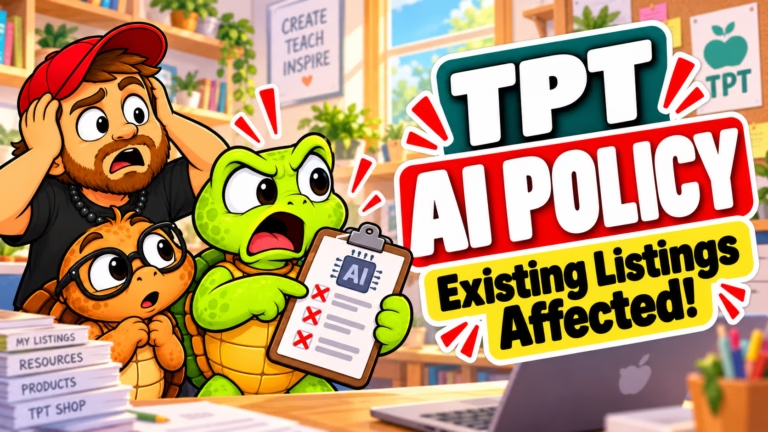
At its October 8, 2026 town hall, Teachers Pay Teachers (TPT) announced plans for an AI-free marketplace, instructed sellers to stop publishing AI-generated content, and told them to begin replacing AI-generated material in existing resources. If you missed that announcement, I covered it in my article about the new TPT AI policy and its impact on existing listings.
But this latest development raises a different set of questions. We’re no longer talking only about what sellers can create using AI. We’re also talking about what the company can potentially do with the educational materials those sellers have spent years creating. And I don’t know about you, but I think that deserves a closer look.
Why Is TPT Banning AI-Generated Content While IXL Offers Spark Studio?
TPT is restricting AI-generated content sold through its marketplace, while its parent company, IXL Learning, offers teachers an AI-powered tool that generates classroom materials. These are different products serving different purposes, but the contrast raises legitimate questions about the company’s approach to artificial intelligence.
IXL Learning acquired Teachers Pay Teachers in March 2023. So while TPT operates as its own educational marketplace, it belongs to the same family of companies as IXL’s other educational products. And one of those products is Spark Studio.
What Exactly Does IXL Spark Studio Create?

According to IXL’s official Spark Studio documentation, the tool helps teachers generate lesson plans and worksheets, interactive review games, scaffolding ideas, translated educational resources, and other classroom materials. Teachers enter information such as their lesson topic and grade level, and Spark Studio generates content they can review and edit. IXL specifically encourages teachers to check the results and make adjustments before using them in the classroom.
That last part makes perfect sense. Nobody wants to hand out a multiplication worksheet that confidently explains how 7 × 8 equals a ham sandwich. But here’s the question. If IXL believes AI can help teachers create useful educational materials, why does TPT want an AI-free marketplace for sellers? You can’t write this kind of irony, lol.
Are TPT and IXL Actually Contradicting Each Other?
Okay, not necessarily. IXL offers Spark Studio as a classroom creation tool, while TPT operates a marketplace where sellers publish and sell educational resources. Using an AI-generated worksheet in your own classroom isn’t automatically the same activity as selling that worksheet to other teachers. That’s a legitimate distinction, and I don’t want to ignore it.
But consider an experienced teacher who uses Spark Studio to generate a worksheet, reviews every question, fixes errors, and adjusts everything to fit their students. IXL encourages teachers to review and edit its AI output. Meanwhile, TPT’s announced restrictions raise problems if a seller wants to publish AI-generated content in a marketplace resource.
The question isn’t whether the two companies must have identical policies. It’s why the parent company promotes AI as a useful tool for creating educational materials while its marketplace takes such a restrictive position on AI-generated content. TPT may have perfectly reasonable business explanations for that difference. The problem is that sellers would simply like to hear their reasoning for that, but so far it’s been crickets.
What Did TPT Say About AI Training on October 29?
On October 29, 2026, TPT updated an official FAQ titled Will TPT use my resources to train AI?. The answer promises that TPT will not use sellers’ resources to train AI that generates competing content without permission. The FAQ also explicitly extends that promise to IXL’s other products and tools, along with outside AI companies. That’s an important statement for sellers, particularly anyone concerned that their educational resources could eventually contribute to an AI system capable of generating similar materials. However, two parts of that statement caught my attention.
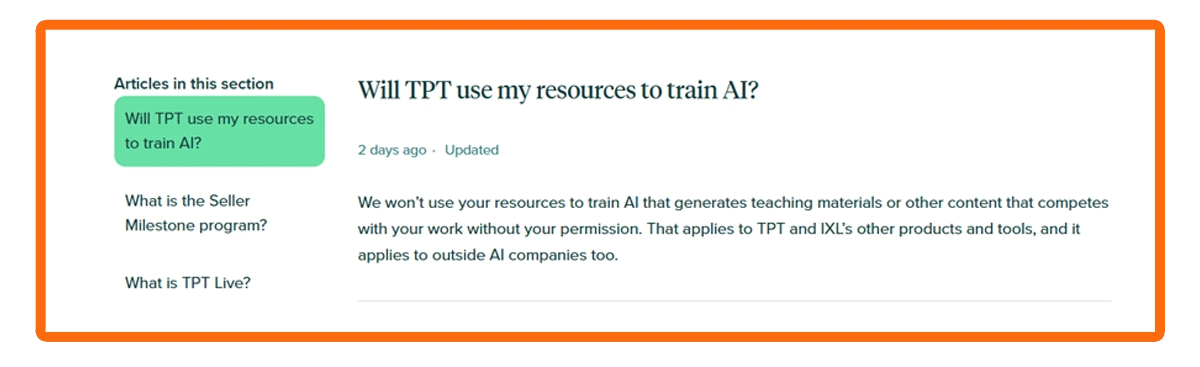
First, TPT specifically refers to AI that generates content competing with sellers’ work. That wording doesn’t clearly explain whether the same protection applies to other kinds of AI training, such as systems designed for search, recommendations, classification, or internal operations. Second, TPT includes the condition that sellers must give permission. And that leads to what I consider one of the biggest unanswered questions.
One important detail here, though. The FAQ displays an October 29 update date. That doesn’t necessarily mean TPT introduced this entire promise on October 29 or changed its actual AI-training practices that day. Without the previous wording, I can’t establish exactly what changed. What I can confirm is what the published statement currently says.
How Would TPT Get Permission to Train AI on Seller Resources?
TPT hasn’t explained how it would obtain the permission referenced in its AI-training FAQ. The published answer doesn’t identify a separate opt-in form, consent checkbox, or process for sellers to approve or reject a specific training request. That doesn’t mean such a process doesn’t exist somewhere else. It means the FAQ itself leaves sellers without a clear explanation. (Sound familiar? It should. They haven’t given any solid direction on their AI Ban Policy either, but I digress.) Is this an actual choice, or one of those “Congratulations, you agreed by logging in!” situations? Because those are two very different definitions of permission, lol.
For example, imagine you’ve spent five years developing original reading comprehension resources. You’ve created hundreds of activities, tested them with students, and built a business around selling them. Now imagine TPT wants permission to use those resources to help train an AI system that generates similar educational materials. Would you receive a separate request asking you to approve that particular use? Would the company offer compensation? Could you refuse while continuing to sell your products? Or could the permission eventually become part of the legal agreement you accept simply by continuing to operate your store? Those are very different situations. And when somebody says they won’t use your work without permission, I think it’s perfectly reasonable to ask what actually qualifies as permission.
Does Uploading Products to TPT Already Give the Company Permission?
TPT’s current Terms of Service grant the company certain rights to use sellers’ uploaded content, but I couldn’t find language explicitly authorizing AI model training. That means I can’t conclude that uploading a resource automatically grants permission for AI training.
I reviewed the Teachers Pay Teachers Terms of Service, which currently display a last-updated date of December 8, 2025. Section 4.B, titled Your Content, explains that sellers retain their intellectual property rights. TPT doesn’t claim ownership of the educational resources sellers upload. However, sellers also grant TPT a nonexclusive, irrevocable, perpetual, worldwide, sublicensable license to exercise certain rights in that content for the purposes of providing its services. That’s a mouthful, isn’t it? I’m convinced legal departments get paid by the syllable.
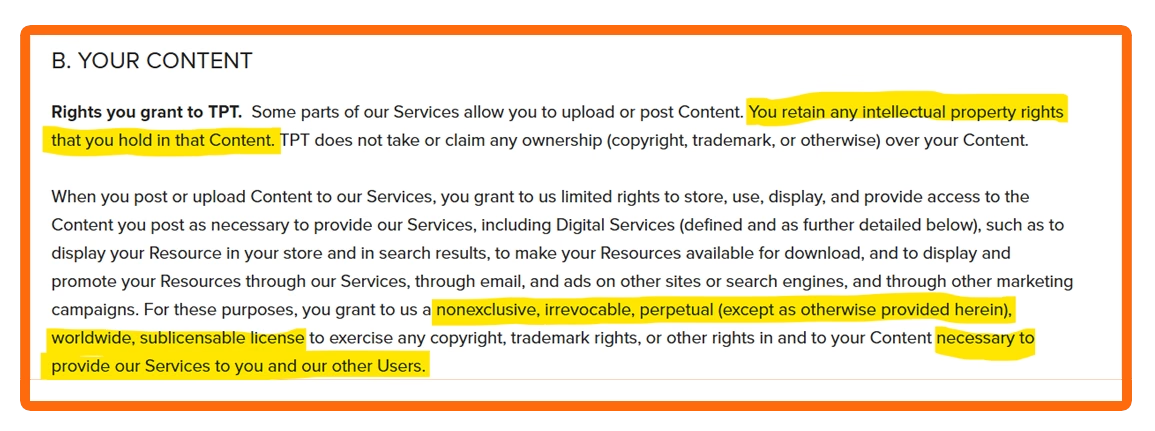
In simpler terms, TPT needs permission to display your products, provide downloads, promote your listings, and operate the marketplace. Without those permissions, it couldn’t do much of what sellers expect it to do. The agreement also covers using resources with certain existing or future digital tools and features offered through TPT’s services.
Does That License Include AI Training?
The published language doesn’t expressly identify training AI models as one of the authorized uses. Its stated purpose centers on providing TPT’s services, including its digital features. That distinction matters.
If you give a store permission to display your handmade cake in its window, that doesn’t automatically tell us whether the store can use your secret recipe to train a robotic baker that makes competing cakes. Okay, maybe that’s an unusual example, but you get the idea, lol.
Permission to use something for one purpose doesn’t automatically settle whether it can be used for every other purpose. The actual agreement, its scope, and applicable law matter.
I’m not a lawyer, so I’m not going to declare that TPT’s current agreement either does or doesn’t provide sufficient legal authorization for a particular form of AI training. What I can say is that I couldn’t find explicit AI-training language in the published Terms of Service, and the October 29 FAQ doesn’t explain how its permission requirement relates to that agreement. That’s a more-than-reasonable question for TPT to answer.
Could TPT Add AI Training Permission to Its Terms of Service Later?

Yes, TPT has a process for revising its Terms of Service, including treating continued use of the platform after changes take effect as acceptance of those changes. However, that doesn’t establish that TPT plans to add AI-training authorization or that any particular future provision would automatically be enforceable. Section 9 explains that TPT may revise its terms and will attempt to notify users before material changes take effect.
It also states that continuing to use the service after the effective date constitutes acceptance under the agreement. This is something sellers should pay close attention to moving forward. If TPT eventually adds AI-training permission to its Terms of Service, continuing to use the platform after those changes take effect could be treated as acceptance under its agreement. Whether that permission would hold up legally is another question, but I certainly wouldn’t want to discover the change six months after agreeing to it.
And this isn’t just some imaginary scenario I pulled out of thin air. Another major online marketplace recently introduced explicit AI-training language into its legal agreement.
Etsy Has Already Taken a Similar Approach to AI Training Permission
Etsy published revised Terms of Use scheduled to take effect on December 16, 2026. In Section 5.C, Etsy explicitly expands its content license to include using member content to develop, train, test, and improve artificial intelligence and machine learning technologies. The provision covers Etsy and certain authorized third parties and is subject to applicable opt-out rights described in Etsy’s Privacy Policy.
That explicit AI-training language doesn’t appear in the older version of Etsy’s Terms of Use that remains effective through December 15. This is significant because Etsy provides a real example of a marketplace incorporating AI-training rights into the agreement governing content uploaded by its users.
I’m not suggesting TPT intends to follow Etsy’s approach. I haven’t found evidence establishing that. But Etsy demonstrates why it’s important to understand whether a marketplace will seek separate, specific permission or attempt to obtain authorization through broader platform terms. Remember when people told us to read the fine print? Apparently, that wasn’t just good advice. It was career training for anyone planning to sell something online, lol. And for sellers who operate on multiple marketplaces, this is becoming an increasingly important issue.
Does IXL Spark Studio Train Its AI Using TPT Sellers’ Products?
I haven’t found reliable evidence that IXL Spark Studio trains its AI using TPT sellers’ resources. In fact, TPT’s official AI-training FAQ specifically promises not to use those resources to train AI that generates competing content without permission, including AI tools operated by IXL.
But while researching this, I discovered something else worth examining. What happens when teachers submit their own original content directly to Spark Studio? That’s a different situation from IXL accessing products listed on TPT, and it brings us back to those all-important Terms of Service.
What Do IXL’s Terms Say About Teacher-Submitted Content?
According to Section 8 of IXL’s Terms of Service, users retain ownership of the content they submit. However, they also grant IXL broad rights to use, reproduce, modify, and create derivative works from that content for purposes connected to its services, business, and affiliates. IXL’s Service Privacy Policy also describes using collected information to develop and improve its educational products. And here’s what caught my attention: IXL’s content license is broad enough that AI training could potentially fall within the rights the company believes it has. The agreement doesn’t specifically mention AI model training, but it doesn’t explicitly rule it out either. That leaves an important question unanswered: Does IXL consider teacher-submitted content fair game for training its AI?
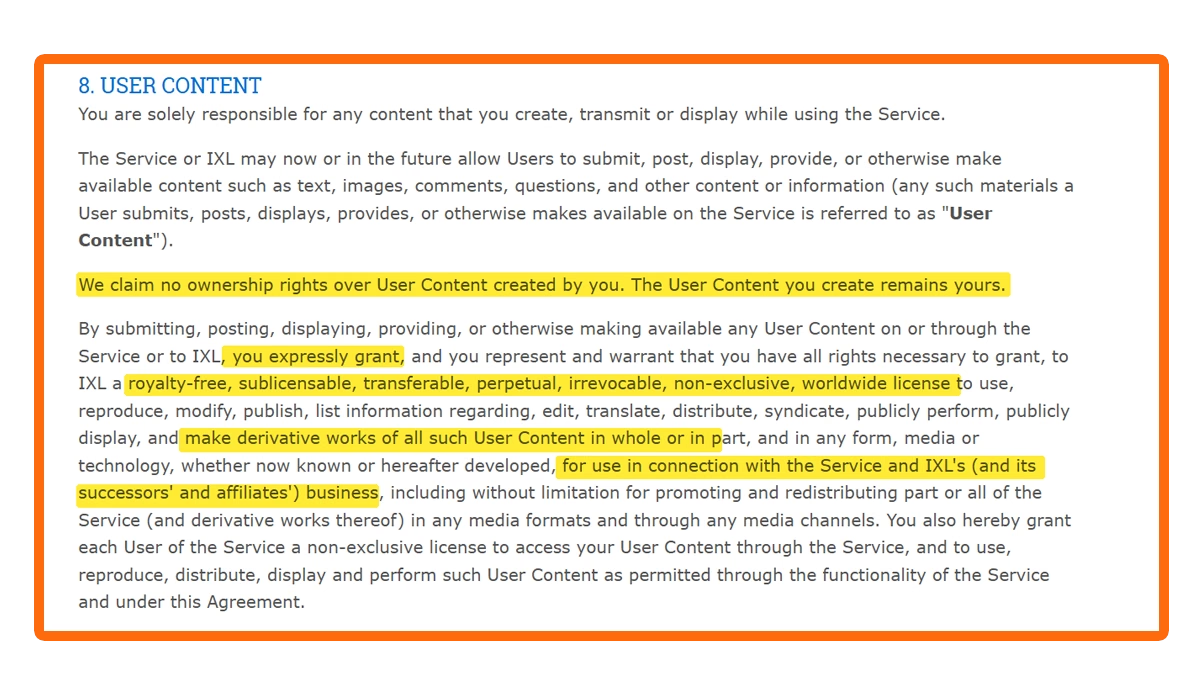
For example, imagine a teacher enters an original lesson about fractions into Spark Studio and asks it to create a simplified worksheet. Does IXL simply process that information to generate the worksheet, or can it also retain and reuse the material to improve its AI? Those are two very different uses, and I couldn’t find a clear answer in the published policies.
And remember, using AI to create something doesn’t automatically mean the AI learns from what you submit. Generating a worksheet and training an AI model are separate processes, even though both involve artificial intelligence.
What Questions About IXL’s AI Training Remain Unanswered?
So we’re left with an important question. If IXL uses teacher-submitted materials to train its AI, does the company believe its existing content license already provides permission? IXL’s content license is broad enough to raise that question, but the agreement alone doesn’t establish whether such training occurs or whether the license legally authorizes it. I also couldn’t find a clear explanation of how IXL interprets those rights when it comes to Spark Studio.
I’m not suggesting that IXL secretly trains AI on TPT sellers’ products or improperly uses teachers’ work. I haven’t found evidence supporting either accusation. But with TPT tightening its AI rules while IXL offers tools that generate educational materials, I think sellers and teachers deserve a clearer explanation of how their original work gets handled.
What Questions Does TPT Still Need to Answer About AI Training?
The biggest unanswered questions concern what TPT considers permission, which kinds of AI training its promise covers, and whether sellers will have meaningful choices about how their resources are used. I’d especially like TPT to clarify whether sellers must explicitly opt in before their resources can be used to train competing AI systems, and whether permission could instead come through existing or future platform agreements.

I’d also like to know whether the company’s protection extends beyond AI systems that generate competing content. The distinction matters because AI can serve many purposes besides generating worksheets or classroom activities. And if sellers grant permission, can they later withdraw it? Would that stop future training, and what would happen to models already trained with their content?
I’m not asking TPT to write an 800-page Stephen King novel here. A few straightforward answers about permission, consent, and what happens to sellers’ work would be a pretty good start. After all, the educators who contribute the materials that make TPT’s marketplace valuable deserve to understand how their work may be used. These are questions about clarity and consent, not accusations that TPT or IXL has violated anyone’s rights.
TPT AI Training: Frequently Asked Questions
Can TPT Use My Resources to Train AI Without Permission?
TPT says it won’t use seller resources to train AI that generates competing teaching materials or other competing content without permission. Its October 29 FAQ extends that promise to IXL’s other products and tools, as well as outside AI companies. The statement doesn’t fully explain how permission is obtained or how other kinds of AI training are handled.
Does IXL Own Teachers Pay Teachers?
Yes. IXL Learning acquired Teachers Pay Teachers in March 2023. TPT operates as an educational resource marketplace within IXL Learning’s broader family of educational brands, which also includes IXL’s AI-powered Spark Studio.
Does TPT Already Have Permission to Train AI on My Products?
TPT’s December 2025 Terms of Service grant the company certain rights to use seller content for its services, but they don’t explicitly identify AI model training. Whether those provisions could authorize a particular training use would require a closer legal assessment. The published AI-training FAQ doesn’t resolve that question.
Can Sellers Opt Out of TPT AI Training?
TPT’s October 29 FAQ doesn’t describe an AI-training opt-out process. It says permission is required for training AI that generates competing content, but it doesn’t explain whether sellers will receive individual requests, how they can refuse, or whether permission can be withdrawn.
Has TPT Confirmed That Spark Studio Uses Seller Resources for AI Training?
No. I haven’t found a verified statement or other reliable evidence establishing that Spark Studio trains on TPT seller resources. The existence of an AI worksheet generator isn’t evidence that it uses content from the TPT marketplace for training.
My Takeaway: TPT Needs to Clarify What Seller Permission Means
I understand why Teachers Pay Teachers wants to protect the value of original educational resources. But I also believe sellers should have a reasonable expectation that the work they’ve spent years creating won’t become training material for competing AI products without their knowledge or permission.
I also understand that TPT and IXL operate different products with different purposes. The existence of Spark Studio doesn’t automatically make TPT’s AI marketplace policy hypocritical, and the October 29 FAQ doesn’t prove the company has done anything wrong. But here’s what bothers me.
TPT is asking sellers to respect strict boundaries around AI-generated content while leaving important questions about its own AI-training permissions unanswered. Those two issues aren’t identical, but both involve how artificial intelligence affects the work and livelihoods of educators. I appreciate that TPT has publicly addressed the training question. I’d appreciate it even more if the company explained exactly what permission means and how sellers would provide it. Because if permission is going to protect somebody’s intellectual property, sellers should know whether they’re signing a separate consent form or agreeing to something buried in a lengthy platform agreement.
What Should TPT Sellers Watch for Next?
And this isn’t the only major change affecting TPT sellers. The company’s move toward a new membership structure also deserves attention, especially for anyone selling educational resources elsewhere. I’ve covered those concerns in my article about TPT’s Exclusive Seller changes and what they mean for Etsy sellers.
I’ll continue following these developments as TPT releases additional guidance, especially about AI training, seller permissions, and how educational resources may be used. If TPT finally gives sellers some straight answers, I’ll update this site with the details. Want those updates delivered to your inbox? Sign up for my free Field Notes below!
And I’d also love to hear what you think in the comments. Does TPT’s October 29 statement give you confidence about how your work will be handled, or would you want a clearer explanation of what counts as permission? Let me know!
Editorial note: This article reflects the information publicly available as of November 1st, 2026. TPT’s policies and statements may change as the company releases additional guidance. My discussion of the platform agreements is informational and does not constitute legal advice.