
Well, the Etsy AI Policy 2026 has certainly decided to shake things up right at the beginning of Q4! On October 22, 2026, Etsy announced new AI restrictions, updated listing image requirements, and plans to strengthen its enforcement against misleading AI-generated content. And judging by the questions I’m already seeing from sellers, there’s plenty of confusion to go around. Do Etsy sellers suddenly need to photograph every print-on-demand product? Are AI-generated mockups banned? Can you still sell AI artwork? And what about all those crochet patterns that look amazing in the listing photos but produce something closer to the creatures from the movie The Thing?
Published: October 23, 2026 | Last updated: October 22, 2026
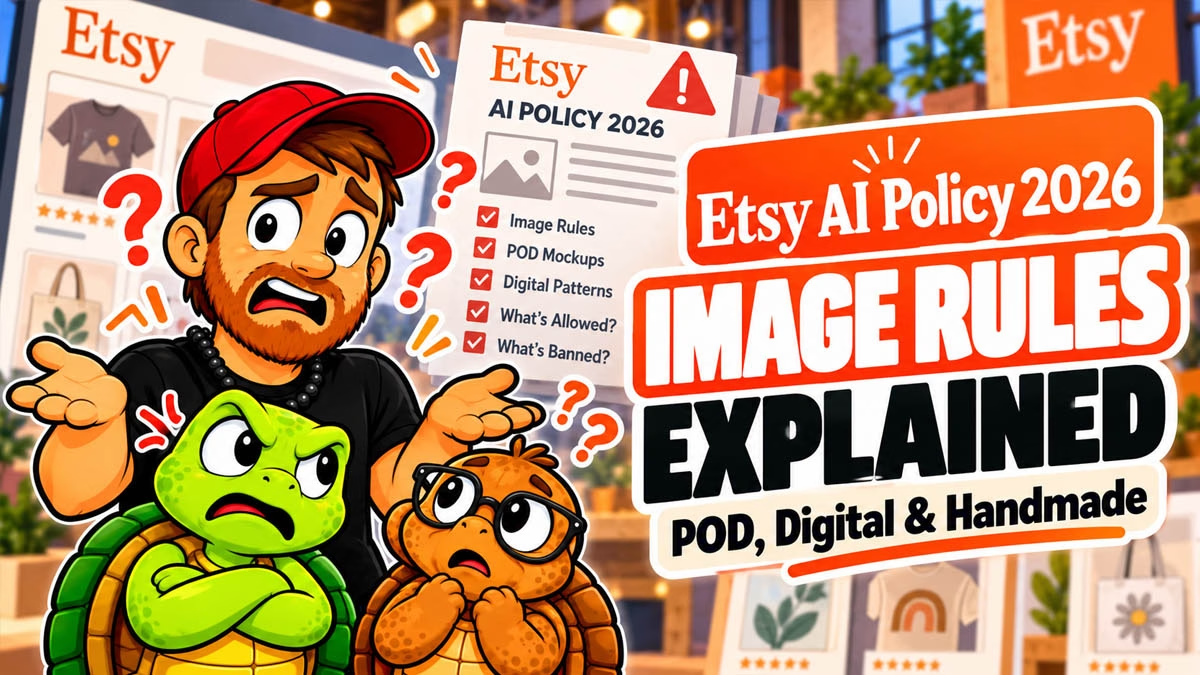
I’ve been digging through Etsy’s announcement, its updated policies, and the questions sellers are raising. I also want to look at how these changes affect three very different types of businesses: print-on-demand, digital products, and handmade or vintage goods. More importantly, I want to separate what Etsy actually says from what people think Etsy says. Because those aren’t always the same thing, and there is a ton of misinterpretation out there.
I’ve also put together a free, one-page Etsy AI Policy 2026 Cheat Sheet covering the important rules, exceptions, and unanswered questions. You can grab your copy at the end of this article without having to sort through all the fine print again.
What Changed in Etsy’s AI Policy on October 22, 2026?
The Etsy AI Policy 2026 release requires more accurate product imagery, restricts AI-generated functional guides, and introduces stronger measures against misleading AI content. However, Etsy has not banned AI-generated artwork or all AI-enhanced listing photos. That’s an important distinction, especially considering some of the reactions I’ve already seen.
According to Etsy’s official October 22 announcement, the changes focus on maintaining buyer trust and making it easier for shoppers to understand what they’re purchasing. Here’s the quick breakdown:
| What’s changing in the Etsy AI Policy 2026 | What sellers need to know |
|---|---|
| Original product photos | Physical products generally require at least one unedited photograph. Etsy provides separate image requirements for qualifying POD, customized, and made-to-order products |
| AI photo editing | Still permitted on additional images when the product remains accurately represented. |
| Print-on-demand mockups | Authorized stock-photo mockups remain permitted for qualifying POD products. |
| Digital downloads | Most visually oriented digital products should show previews or excerpts of their actual contents. |
| AI-generated patterns | AI-generated functional guides, including patterns, recipes, and instructions, are prohibited. |
| Finished-result photos | Patterns, recipes, seeds, and similar products require at least one real, unedited photograph. |
| AI-generated artwork | Still permitted when it meets Etsy’s Creativity Standards and disclosure requirements. |
| Automated listings | Bot-generated listings without human involvement are prohibited. |
| Enforcement | Etsy is introducing image-upload guidance, stronger detection, and additional reporting options. |
These changes also affect existing listings that don’t meet the updated requirements. And Etsy chose to announce them just as sellers are preparing for the holiday shopping rush. That’s going to go over like a fart in church. Still, I can understand Etsy’s reasoning behind some of these changes. Buyers deserve to know what they’re purchasing, and legitimate creators shouldn’t have to compete with misleading listings. The trouble comes when we start digging into the practical details.
Does the Etsy AI Policy 2026 Now Require Real, Unedited Product Photos?
Yes. Etsy now requires at least one unedited photograph of the actual item against a real background for most physical products, although certain product categories have exceptions. And Etsy isn’t talking about a photograph that’s been touched up to look natural. Its policy describes an unedited photograph as one that hasn’t been altered or changed in any way. That means the photograph used to satisfy this requirement shouldn’t have its background replaced, colors adjusted in editing software, defects removed, or appearance enhanced with AI.
However, this requirement doesn’t apply identically to every Etsy product. For example, authorized POD stock mockups receive an exception, digital downloads have separate guidance, and certain customized products may use photographs of previously completed work. You can review these distinctions in Etsy’s Listing Image Requirements policy.
Does Etsy Require the Unedited Photo to Be the First Listing Image?
No. Etsy’s October 22 image-policy update does not generally require the unedited photograph to appear first. However, separate Creativity Standards impose specific first-image rules on certain customized products. This is one of the biggest misunderstandings I’ve encountered. Etsy recommends using your clearest, most realistic image as the first listing photo. But that recommendation doesn’t mean every product’s first photograph must be completely unedited. So, for a typical handmade product, you may be able to lead with an attractive, accurately edited lifestyle photograph and include the required original photograph elsewhere in the listing.
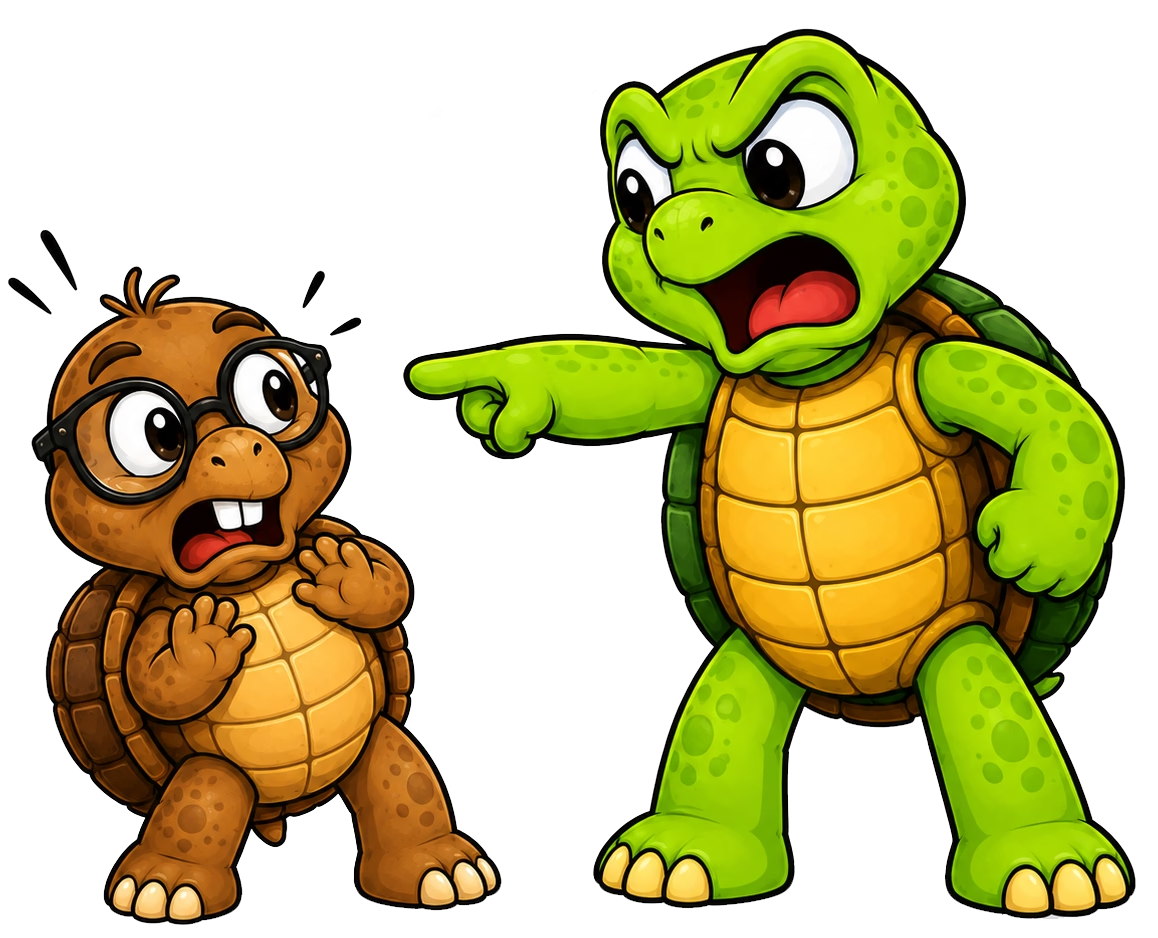
There is an important exception. Under Etsy’s Creativity Standards, sellers listing certain personalized or custom products must show a finished, customized example in the first image rather than a blank product or placeholder text. That rule appears in Etsy’s standards for both items made by sellers and items designed by sellers. It should not be confused with a universal rule requiring everyone’s first photo to be unedited. In other words, your listing category matters.
And thank goodness Etsy hasn’t told every seller to replace their carefully styled thumbnails with whatever they could photograph on the kitchen counter. The marketplace might look like tornado wreckage overnight if that was the case, lol. No way would they want that! I’m all for showing buyers what they’re actually getting, but if Etsy ever requires every seller to use an untouched photograph as their first listing image, Sheldon may have to start offering emergency photography lessons. And trust me, that turtle doesn’t have the patience for it.
Can Etsy Sellers Still Edit Their Other Listing Photos?
Yes. Etsy allows traditional photo editing and AI-powered editing on additional listing images, provided those edits don’t misrepresent the product. Permitted examples include adjusting lighting, correcting color balance, cropping, resizing, straightening, and changing backgrounds.
But Etsy draws the line at misleading alterations. You cannot use editing tools to conceal cracks, remove damage, change the actual product’s color, or make its materials and features look different from what buyers will receive. And this is where I think a real-world demonstration helps.
My Experiment: When Does a Better Product Photo Become Misleading?
For this example, I’m using a real physical mug rather than a completely fictional product. The first image is my starting example, using a real photograph of a physical mug with Tater’s design added digitally. From there, I wanted to demonstrate what happens when we start making changes to the photograph. But let’s say the flash was too bright and I wanted to make it look more natural using AI. The second uses AI to improve the presentation while preserving the mug’s actual appearance. But let’s say I don’t think that is flashy enough to sell on Etsy, so I went with the full “Buy Me Now!” AI treatment. The third image pushes things further, changing how the product looks in a way that could create unrealistic expectations.
Now this is a completely exaggerated example with the gold rim and handle (though with some products on Etsy, you’d be surprised, lol), but you get the point. Even the shape and size of the mug have changed from the 11 oz mug from the original. That third one is completely misrepresenting what I’m actually selling. The purpose isn’t to determine whether Etsy approves a particular editing tool. It’s to demonstrate the difference between presenting a product attractively and presenting a product inaccurately.
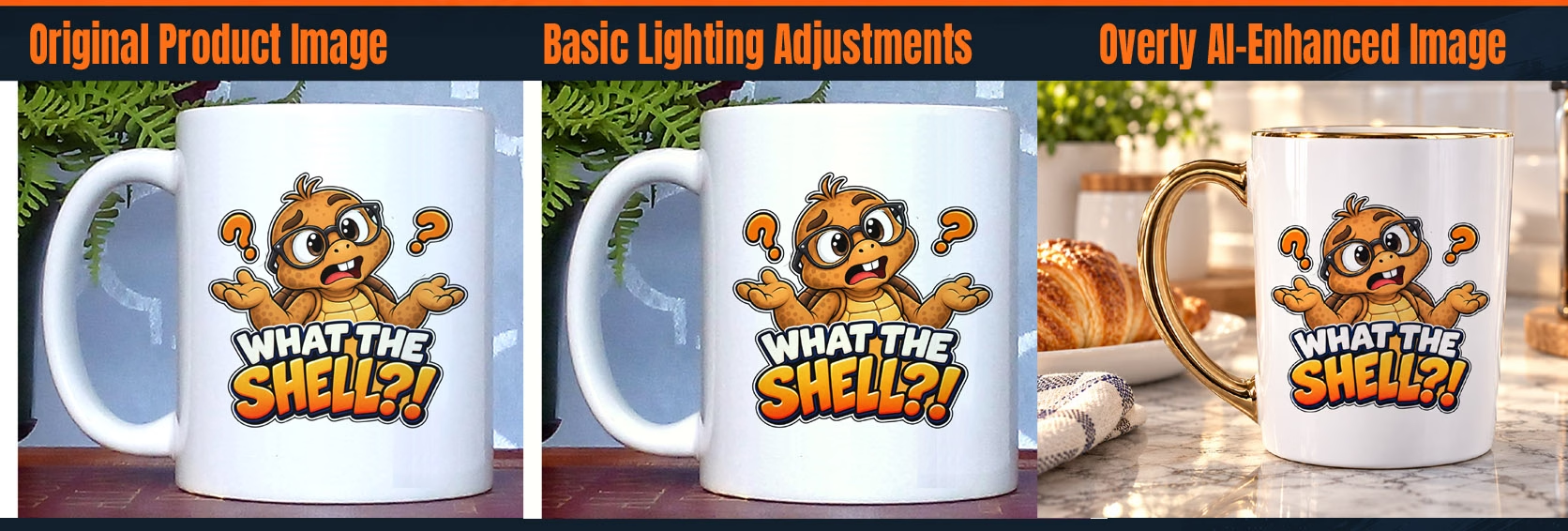
And there’s another question worth considering. If I photograph a mug in my kitchen and use AI to remove the clutter from the background, Etsy allows that type of editing on an additional image when the product remains accurate. But that cleaned-up version wouldn’t satisfy the unedited-photo requirement for an ordinary physical product. One photograph can demonstrate what the product really looks like. Another can show how it might look in a more attractive setting. Both still need to tell the truth.
Can Print-on-Demand Sellers Still Use Mockups According to the Etsy AI Policy 2026 Notice?
Yes. Etsy explicitly allows authorized stock-photo mockups when a production partner prints a seller’s original design on a standard base product, such as a T-shirt or mug. That means qualifying POD sellers don’t automatically need to purchase and photograph every product in their catalogs just to comply with the new unedited-photo requirement. Which is probably a relief to anyone with several hundred Printify listings. Because if you’ve got 500 POD listings, ordering a sample of every single product could get expensive in a hurry. I’d have to sell Tater’s shell just to pay for them, and I don’t think he’d appreciate that arrangement.
Here’s the important wording from Etsy’s POD image requirements: The production partner must print your original design on a standard base product, and the owner of the stock photograph must authorize its use. That makes the source and authorization of the mockup important. A mockup supplied by your POD provider for authorized use isn’t necessarily treated the same way as an image you create entirely with generative AI. And don’t forget that Etsy’s other requirements still apply. Your design must qualify under its Creativity Standards, and sellers using production partners must make the appropriate disclosures.
Can AI-Generated POD Mockups Look Identical to Authorized Mockups?
Yes, AI can produce images that look extremely similar to conventional POD mockups. But visual similarity alone doesn’t establish whether an image complies with Etsy’s policies. My question isn’t whether someone should use AI to imitate an authorized mockup or whether the resulting image will fool Etsy. It’s whether Etsy has clearly explained how it distinguishes an authorized stock-photo mockup from a completely AI-generated image that accurately depicts the same product.
The policy clearly permits qualifying authorized stock mockups. It also permits certain AI-edited additional images. What it doesn’t do is explain every possible situation involving entirely AI-generated product mockups. And if two images look nearly identical to a shopper, what information does Etsy use to determine how each image was created and whether it meets the rules? I think sellers deserve a clearer answer.
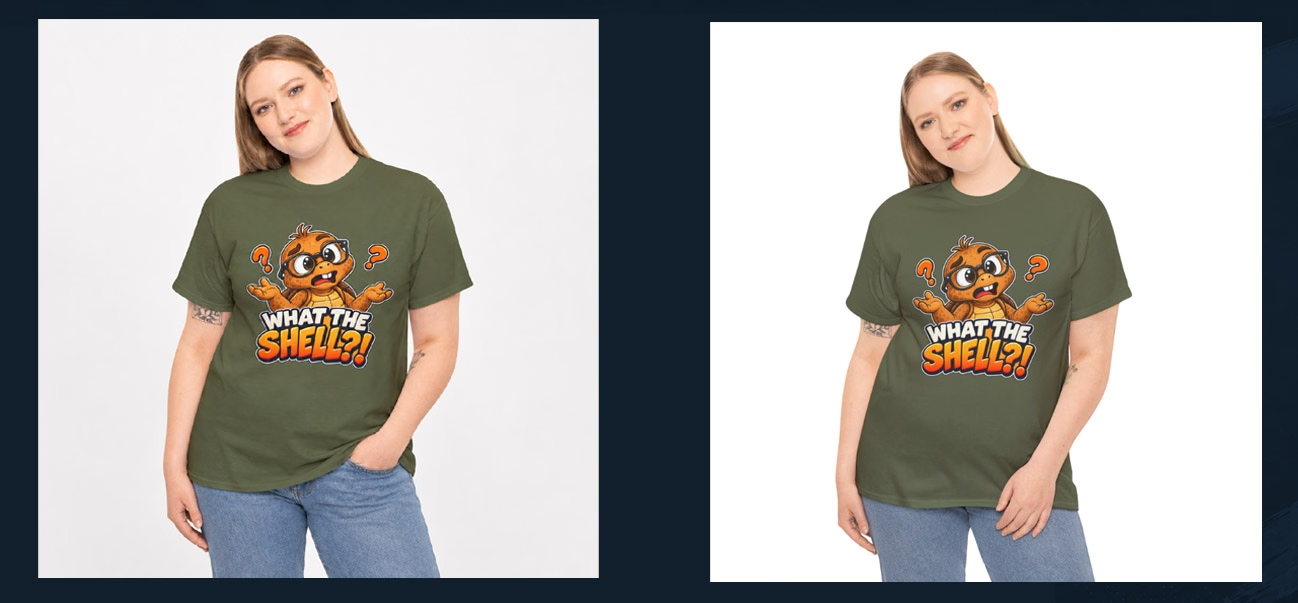
But the question remains: how would Etsy even know the difference? I know image files can contain metadata that offers clues about how they were created, but that information isn’t always available or reliable. And Etsy hasn’t explained exactly how its AI detection system will distinguish authorized POD mockups from AI-generated lookalikes. Here’s a basic example. For the record, I wouldn’t personally use either of these images in my listings, but take a good look and see if you can tell which one came from Printify and which one AI created.
Which POD Mockup Was AI-Generated, and Does It Matter?
So, which one is which? The image on the left is AI-generated, while the one on the right is the original Printify mockup. There are some subtle differences in the model’s appearance, pose, and clothing, but at first glance, both look like perfectly normal POD mockups.
Now, I’m not suggesting that an AI-generated mockup automatically violates Etsy’s rules. That depends on how the image was created, how it’s used, and whether it meets Etsy’s requirements. But here’s my point: If the two images look nearly identical to buyers, how will Etsy determine which one qualifies under its authorized POD mockup exception? That’s something I’d love to see Etsy explain in more detail. Because when these new detection tools start reviewing existing listings, sellers deserve to know how those decisions will be made.
Do Posters, Canvas Prints, and Other POD Products Qualify for the Exception in the Etsy AI Policy 2026?
They may qualify when they meet Etsy’s stated conditions, but Etsy doesn’t provide an exhaustive list of eligible POD products. Its policy mentions T-shirts and mugs as examples, not necessarily the only qualifying items. A poster or canvas featuring your original design and produced by an authorized printing partner would appear consistent with the general wording.
However, sellers shouldn’t assume that every product, every mockup provider, or every image-generation workflow automatically qualifies. I’d like Etsy to provide more detailed examples covering wall art, blankets, home decor, and other common POD categories. Because, believe it or not, not every print-on-demand seller spends their entire life designing T-shirts.
Can Etsy POD Wall Art Sellers Use AI-Generated Room Mockups?

Etsy allows authorized stock-photo mockups for qualifying POD products, but it hasn’t clearly stated that independently AI-generated room mockups qualify for the same exception. Wall art presents an interesting situation because sellers often use digital artwork files to create product images for posters, framed prints, and canvases. Some use mockups supplied by Printify or another production partner, while others build their own using Photoshop, Canva, or AI-generated room scenes. Some of these AI-generated rooms look better than anything I’ve ever lived in. I’m half tempted to ask AI whether I can move into one. Unfortunately, that still doesn’t tell me whether Etsy considers the mockup compliant.
Here’s where sellers need to be careful. The original PNG or JPG containing your artwork isn’t automatically a photograph of the finished physical product. And placing that artwork into an AI-generated living room doesn’t necessarily make the resulting image an authorized POD stock-photo mockup. Etsy specifically allows qualifying POD sellers to use stock-photo mockups when the owner has authorized their use. It also allows AI editing on additional listing images, provided those images accurately represent the actual product.
But what about sellers whose entire collection of listing images consists of independently AI-generated room mockups? If those images accurately show the print’s size, framing, materials, and appearance, will they consider them acceptable under the new Etsy AI Policy 2026? That’s something serious I’d like Etsy to clarify, particularly for sellers offering hundreds of artwork designs who can’t realistically purchase and photograph every variation.
Are Etsy’s Own Digital-to-Print Listings Following the Same Image Rules?
Etsy’s own Creativity Standards prohibit placeholder text as the first image on personalized products, yet Ventur Editions, the shop involved in Etsy’s digital-to-print experiment, continues to use “Your Design Here” images on its listings. I’ve been following Etsy’s digital-to-print experiment involving Ventur Editions, and I couldn’t help noticing something. One personalized poster listing has exactly one image, featuring a repeating pattern and the words “Your Design Here.” No additional photographs show a finished product with an actual design. And that’s not even touching the other Ventur Editions listings displaying similar placeholder images.
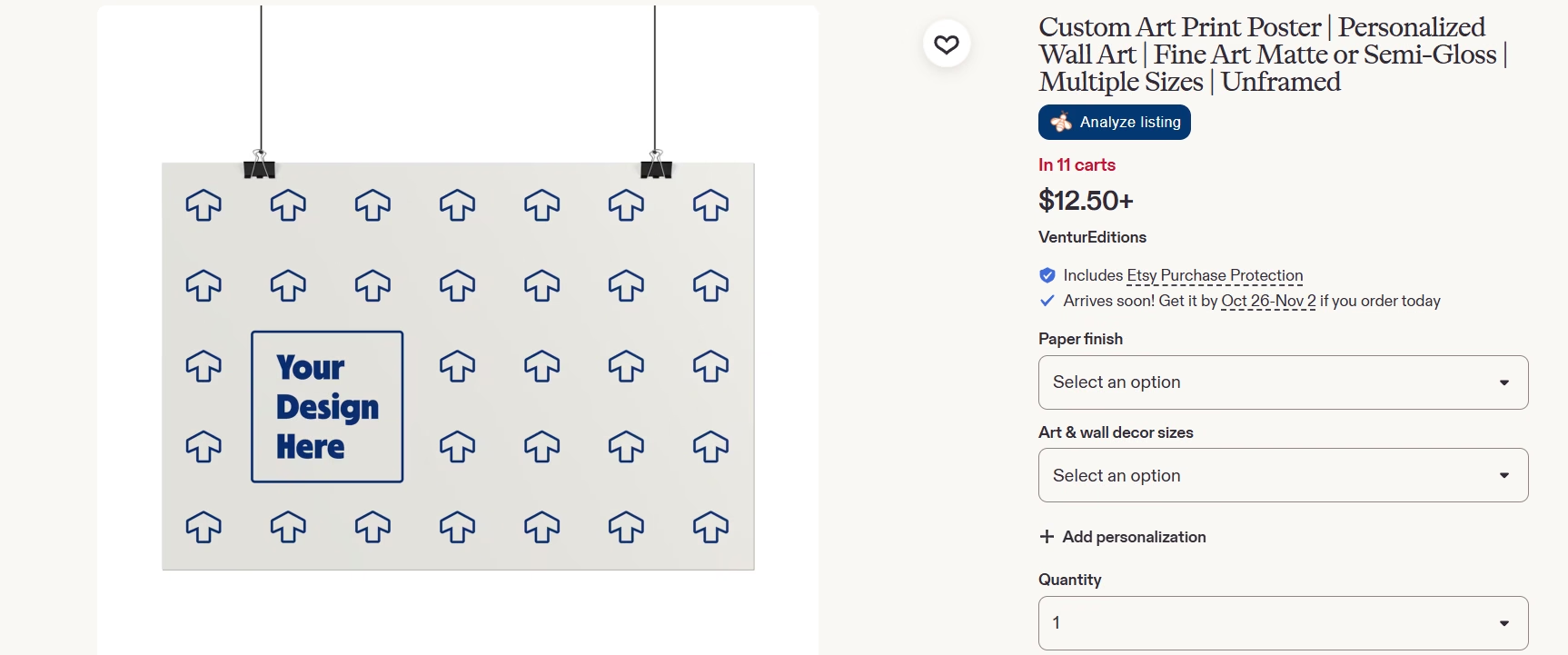
Under Etsy’s official Creativity Standards, the rules for both Made by a Seller and Designed by a Seller state that the first image of a personalized or custom product must show a finished, customized item rather than a blank product or placeholder text. Etsy even gives “Your Text Here” as an example of what sellers can’t use. And the Designed by a Seller category specifically includes original designs produced by third-party production partners. So simply using a production partner doesn’t automatically exempt a personalized listing from that first-image requirement.
Now, Etsy’s updated Listing Image Requirements do permit authorized mockups for qualifying print-on-demand products. But that doesn’t clearly override the separate requirement concerning placeholder images on personalized listings. So why does Etsy’s own digital-to-print experiment appear to be doing exactly what its published Creativity Standards tell other sellers not to do? Is Ventur Editions operating under a special exception? Does Etsy interpret these rules differently for buyer-uploaded designs? Or is this something that simply hasn’t been addressed? I don’t know the answer, but I’d certainly love to hear Etsy explain it. Just throwing that out there to stir the pot a little. LMAO!
What Does the Etsy AI Policy 2026 Mean for Digital Download Sellers?
Digital sellers can still sell qualifying AI-generated artwork, but Etsy now prohibits AI-generated functional guides and expects most visually oriented downloads to include previews of their contents. The important thing to understand is that digital downloads aren’t all the same. A printable illustration, crochet pattern, spreadsheet, audio file, and instructional guide serve very different purposes. And Etsy treats some of them differently.
Do Digital Downloads Need Real Photographs or Product Previews?
Digital downloads don’t all require photographs of physical products. Etsy has separate image guidance depending on whether the item has visual content. For digital files without visual elements, such as audio recordings, Etsy allows representative imagery, including AI-generated images, provided it doesn’t mislead buyers. For other digital downloads, Etsy says sellers should include a visual preview or excerpt of the content buyers will receive. That wording is important.
The Etsy AI Policy 2026 uses “should” here, rather than the mandatory language used elsewhere in the policy. I’d still recommend showing buyers the actual product whenever possible. For printable artwork, that could mean displaying the design itself. For a digital planner, it might mean showing several actual pages. And for a spreadsheet? Well, that brings us to another interesting example.
How Should Etsy Sellers Show Digital Spreadsheets and Templates?
Actual screenshots containing representative sample data are a sensible way to show buyers what a spreadsheet or digital template includes. Etsy hasn’t published detailed rules for every type of spreadsheet preview.
Suppose you’re selling a budget tracker in Excel or Google Sheets. You could show its dashboard, worksheet tabs, charts, or formulas in action. But what if you use AI to create a beautiful dashboard image that doesn’t actually match the spreadsheet buyers receive? That’s where accurate representation becomes important.

A buyer shouldn’t purchase a basic spreadsheet expecting a polished financial dashboard that doesn’t exist in the download. I’d love more specific guidance from Etsy about interactive digital products, particularly those whose functionality can’t be fully demonstrated through a static image. I mean, come on, Etsy. Why are we making this more complicated than it needs to be? If somebody buys a budget spreadsheet expecting a beautiful financial dashboard but receives three blank columns and a calculator, I think we’ve got a problem. Even Tater could tell you that, and he’s still trying to figure out why his piggy bank doesn’t accept lettuce.
Are AI-Generated Crochet Patterns Banned On Etsy?
Yes. The Etsy AI Policy 2026 now prohibits AI-generated functional guides, including crochet patterns, knitting instructions, recipes, and similar products that buyers rely on to make or use something. This may be one of the most significant changes in the announcement. Etsy isn’t simply asking crochet sellers to provide better listing pictures. It’s restricting how the actual instructions can be created. The information buyers depend on must represent the seller’s own work rather than instructions generated by AI.
And I can understand why this matters. Imagine buying a crochet pattern because the listing shows an adorable little turtle. You purchase the instructions, spend hours following them, and discover that the finished result looks nothing like the advertised animal. Or worse, the pattern includes impossible stitches, missing steps, or instructions that don’t produce a usable finished project. I’d be pretty irritated, too.
But here’s an important distinction: even if an AI-generated pattern happens to work, Etsy’s new policy still prohibits AI-generated functional instructions. Simply testing an AI-written pattern doesn’t automatically turn those instructions into the seller’s original work.
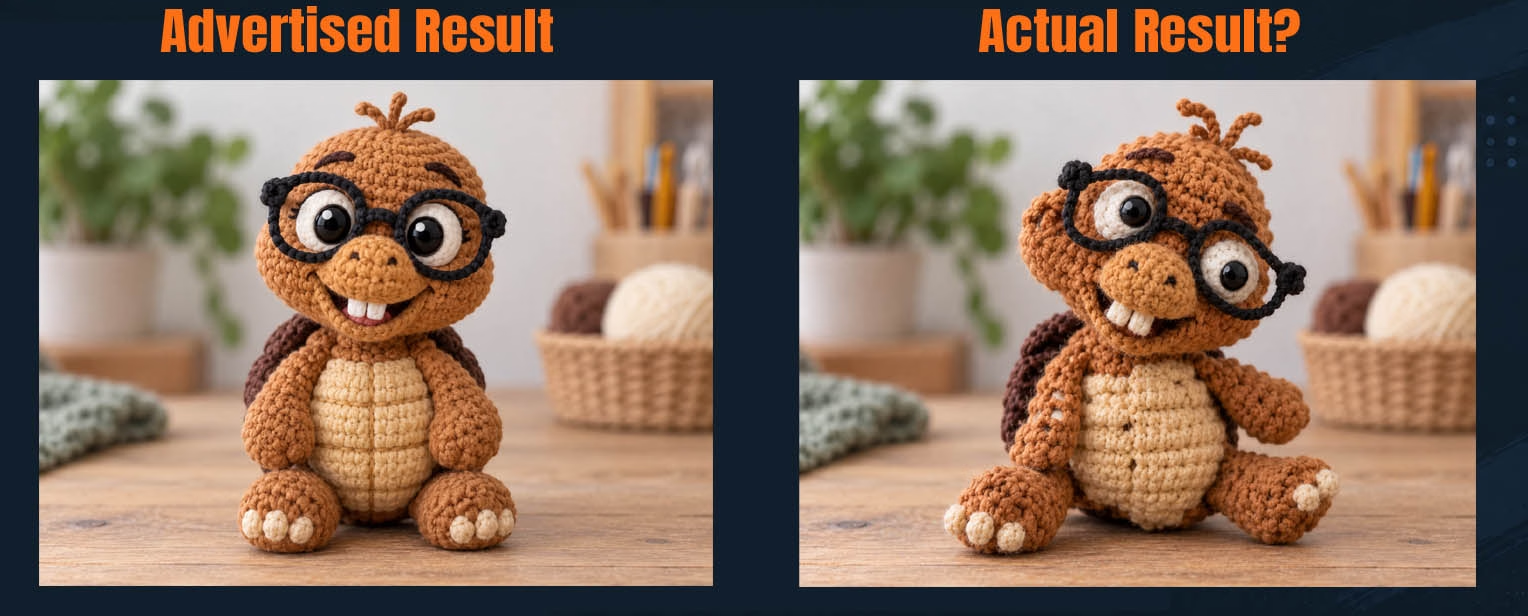
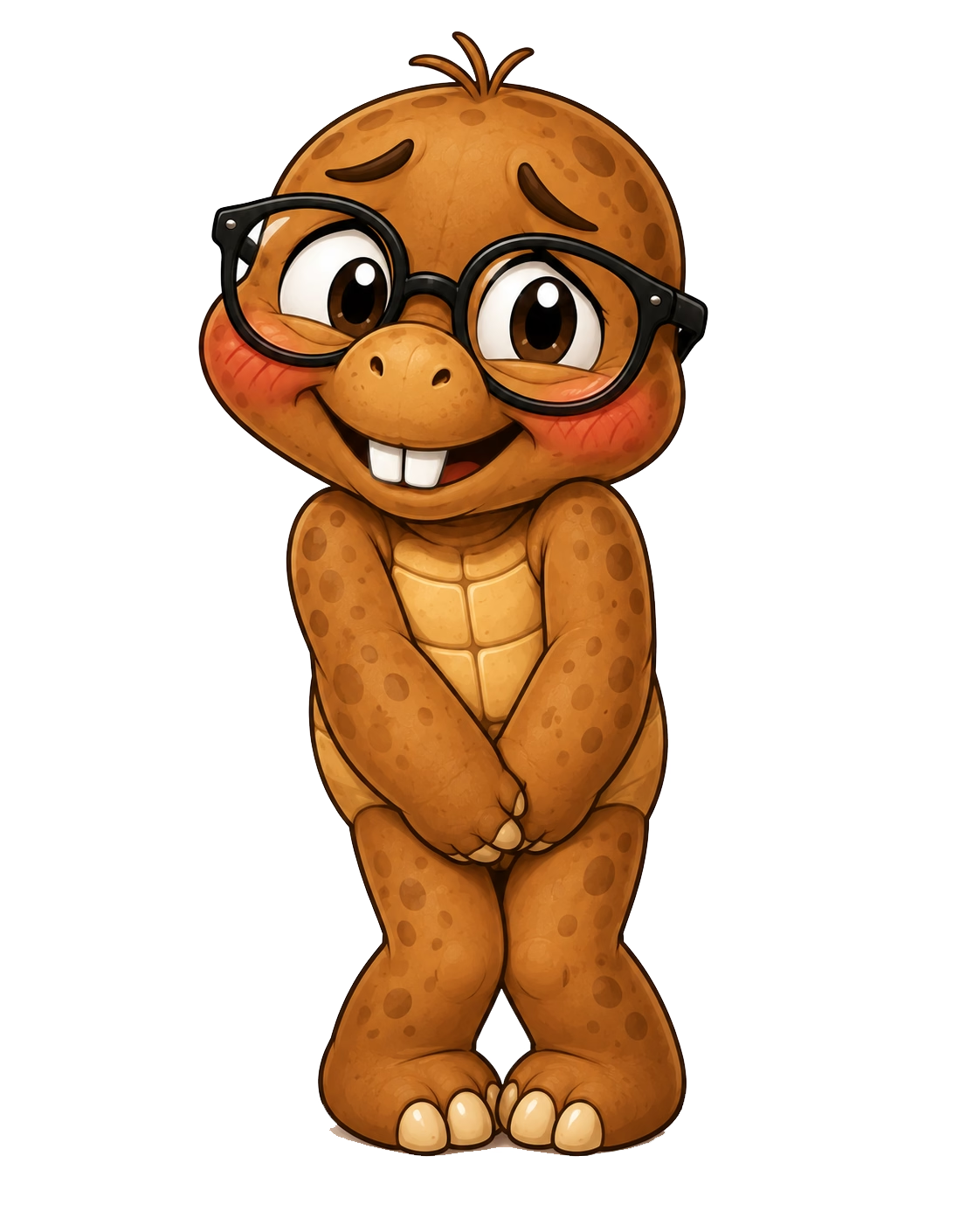
Now, before anyone gets upset, I realize that a finished crochet project also depends on the skill of the person making it, lol. An experienced crocheter and someone picking up a hook for the first time might produce two very different results using the exact same pattern. So a project turning out looking like poor Tater here doesn’t automatically mean the pattern is defective or AI-generated. But when sellers advertise a finished product that their instructions can’t realistically produce, that’s an entirely different problem. And for the record, both of these Tater examples are AI-generated illustrations. I didn’t actually test a crochet pattern. Although looking at that second turtle, I’m almost tempted to try. LMAO!
Do Crochet Sellers Need Photos of the Actual Finished Project?
Yes. Etsy requires sellers of craft patterns and similar products to include at least one real, unedited photograph of an actual result made using the instructions. For crochet sellers, that means showing something genuinely produced from the pattern. Not just a beautiful AI-generated illustration of what the finished project supposedly looks like.
One thing worth clarifying is that Etsy requires an actual finished result, but the policy doesn’t explicitly say the seller must personally create or photograph every example. Whether a customer’s completed project or another authorized photograph would satisfy the requirement is something Etsy needs to explain.
The same general finished-result requirement applies to other qualifying products, including recipes, seeds, and similar items. Etsy specifically gives examples involving completed crochet projects and flowering plants grown from seeds.
This distinction could help buyers make more informed decisions, especially beginners who may not know whether a pattern’s advertised result is physically achievable. And it’s also an opportunity for legitimate crochet designers to show the real craftsmanship behind their work.
Do Etsy’s Finished-Result Photo Rules Apply to Seeds and Building Plans?
The Etsy AI Policy 2026 explicitly includes seeds in its finished-result photo requirements, but it hasn’t clarified how those rules apply to large woodworking or construction plans. And that raises some interesting practical questions. But here’s where I think Etsy needs to provide some clarification. What happens if someone sells hundreds of different seed varieties? Are they expected to grow every plant before listing the seeds, or can they use an actual photograph supplied by a grower?
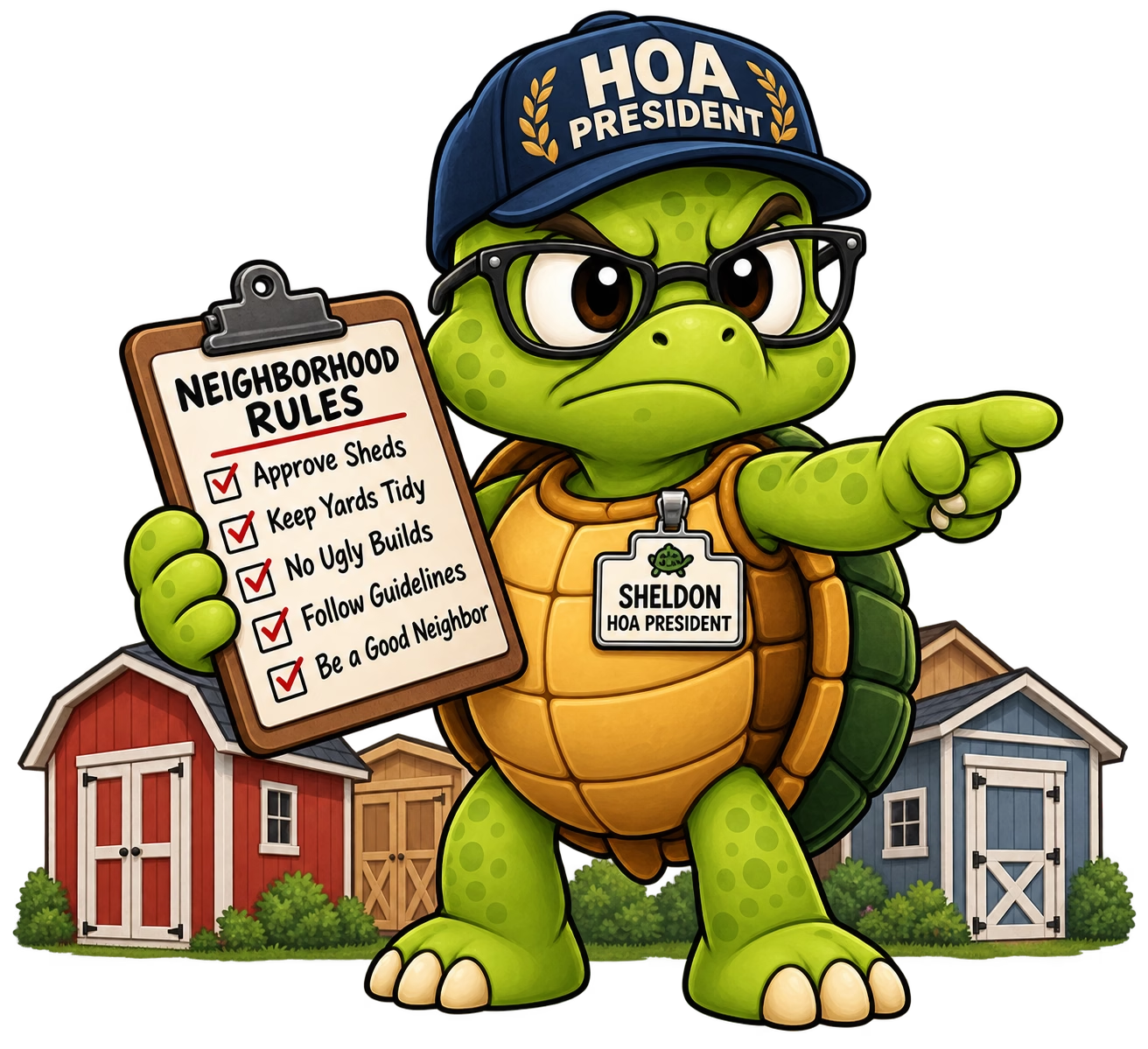
And what about woodworking plans? If someone sells downloadable instructions for building a 12-by-16-foot shed, does Etsy expect them to build an actual shed just to photograph it? Would a customer’s completed project count, or could detailed architectural drawings satisfy the requirement? If I sold 50 different shed plans and had to build every one of them for photographs, I’d have enough buildings to start my own neighborhood. Sheldon could be the HOA president, which is probably the most terrifying part of that scenario.
Etsy specifically mentions craft patterns, recipes, and seeds, but doesn’t explain how its finished-result requirements apply to every type of instructional product. I’d certainly like to see more examples, especially for products that take months or even years to complete.
Are AI-Assisted Cross-Stitch, Knitting, or Sewing Patterns Also Affected?
Yes, the prohibition applies to AI-generated functional instructions beyond crochet. However, Etsy hasn’t clearly explained every boundary between AI-generated artwork and functional pattern instructions. Consider a cross-stitch seller who uses AI to create an illustration and then manually converts that image into a workable stitch chart. Is the final chart seller-created functional work, or does Etsy consider it an AI-generated guide?
What about software that automatically converts artwork into a chart? Those aren’t necessarily identical situations, and Etsy’s announcement doesn’t resolve every variation. I wouldn’t automatically assume every design created with AI assistance violates the new rule. But I also wouldn’t assume an AI-generated chart is acceptable simply because a seller edited it. This is another area where I’d like Etsy to publish more detailed examples.
Can Sellers Use AI to Proofread or Improve Their Own Patterns?
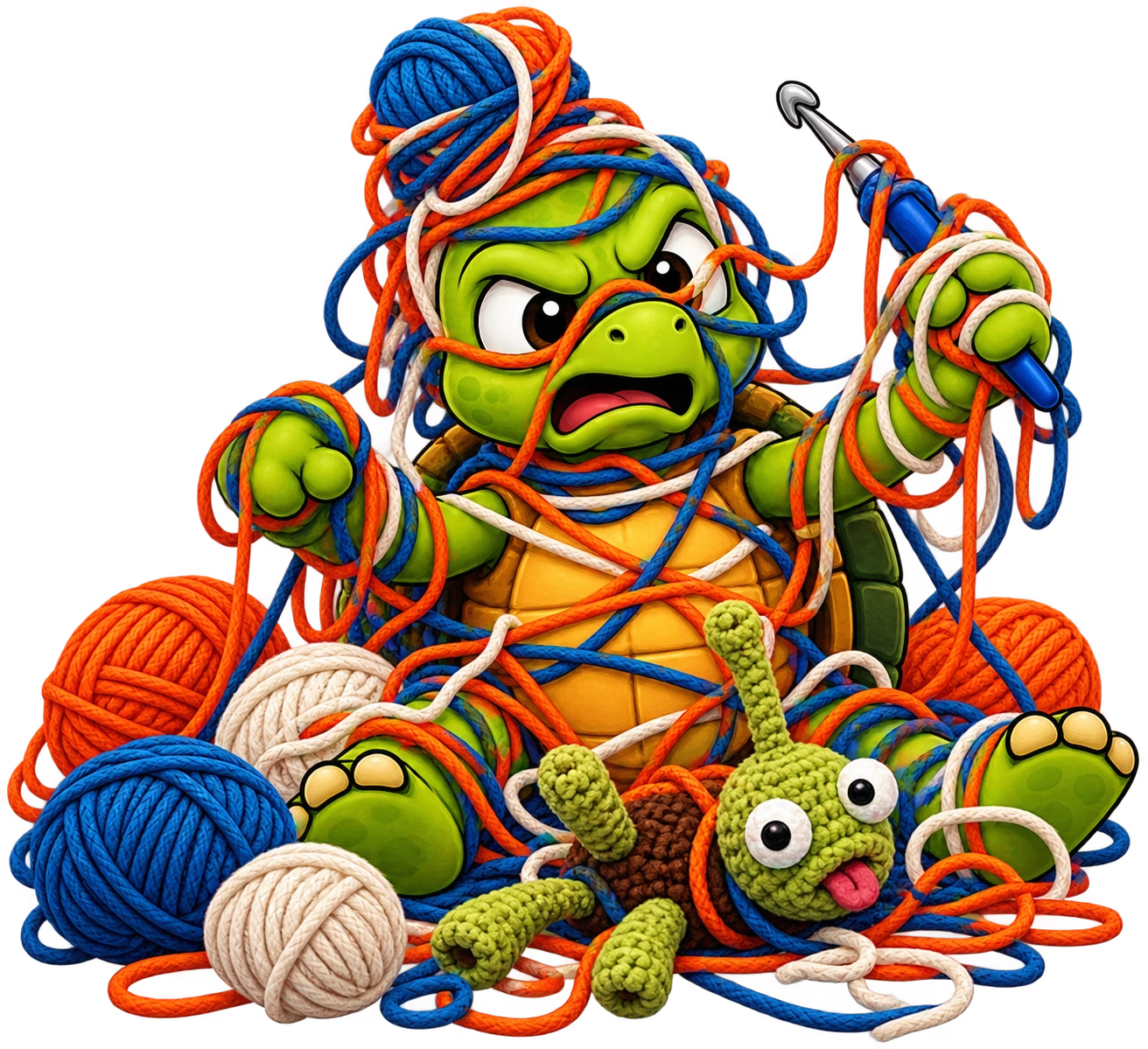
The Etsy AI Policy 2026 release hasn’t specifically clarified how limited AI assistance, such as proofreading or formatting seller-written instructions, fits within the new functional-guide restriction. There’s a meaningful difference between asking AI to write an entire crochet pattern and asking it to correct spelling in instructions you created yourself. But where does Etsy draw the line? What if AI translates a seller’s original pattern? What if it rewrites confusing steps? And at what point does editing become generating the functional information itself?
Until Etsy clarifies those situations, sellers should be careful about assuming that every form of AI assistance receives an exemption. There’s a pretty big difference between asking AI to fix a typo and asking it to invent an entire crochet pattern. One might save you from a spelling mistake. The other might leave you wondering why your finished turtle has three legs and a tail growing out of his forehead.
Can Sellers Still Sell AI-Generated Artwork Under the New Etsy AI Policy 2026?
Yes. Etsy continues to allow qualifying AI-generated artwork when sellers contribute original creative input, disclose AI use, and comply with the marketplace’s other policies. This is where Etsy’s approach differs considerably from the direction other marketplaces are taking. Under Etsy’s Creativity Standards, seller-prompted AI creations can qualify as items designed by a seller. Examples include artwork generated from a seller’s original prompts and creative inputs. But Etsy requires sellers to disclose AI use in the listing description. Sellers also cannot misrepresent AI-generated work as something entirely handmade or created without AI. It’s important not to confuse this mandatory disclosure with Etsy’s separate recommendation to tell buyers when listing photographs have been edited with AI. Those aren’t the same requirement.
And if you’ve been following the controversy surrounding Teachers Pay Teachers, you’ll recognize a very different approach. I recently covered the TPT AI policy and its restrictions on AI-generated educational resources. At least Etsy isn’t taking that same broad approach to AI-generated creative content. Etsy is continuing to permit certain AI artwork while drawing a stricter line around functional instructions and misleading listings. Whether it can enforce those distinctions consistently remains to be seen.
How Does the New Etsy AI Policy 2026 Affect Handmade and Vintage Sellers?
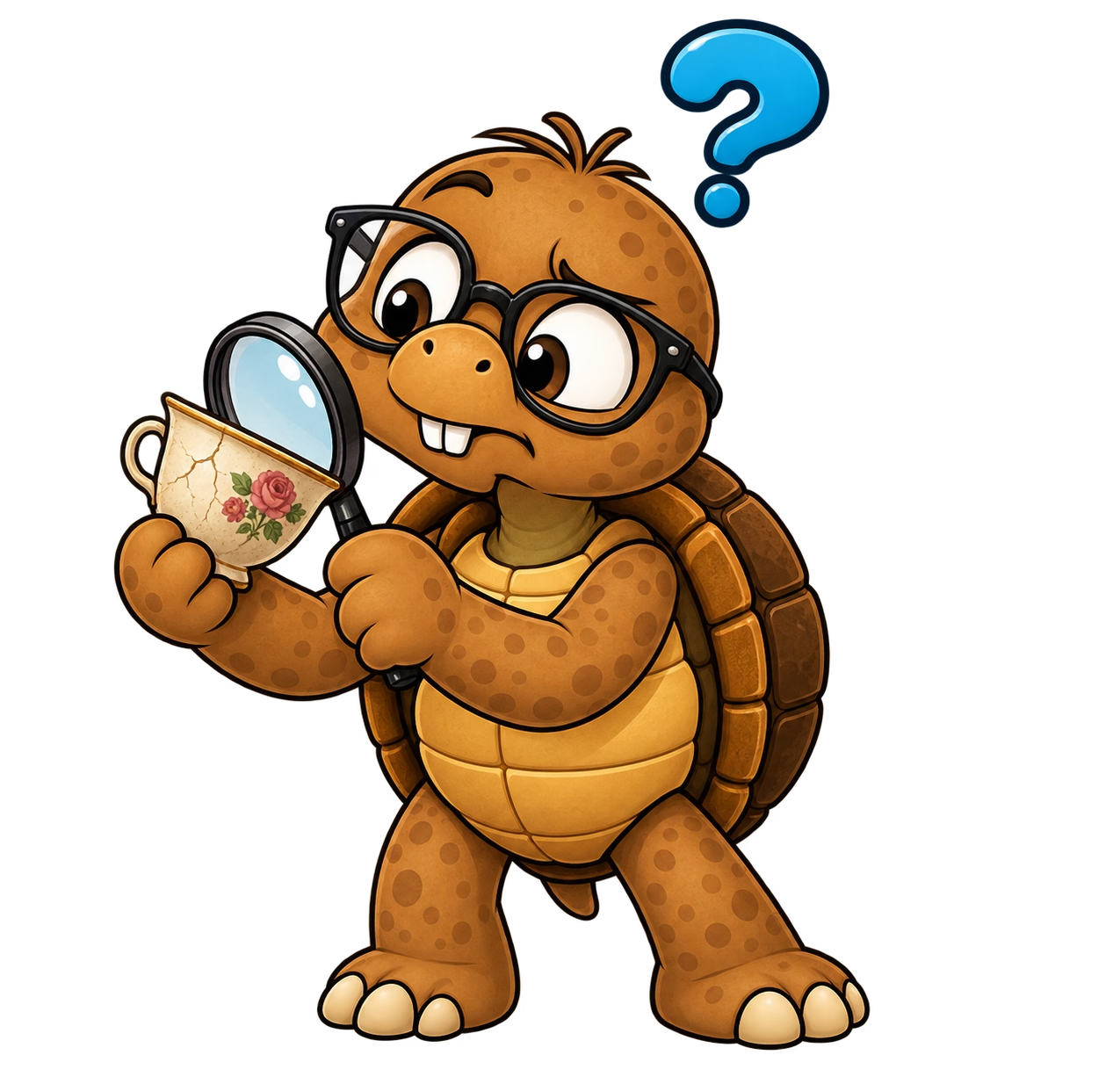
Handmade and vintage sellers generally need a real, unedited photograph of the physical item, and every listing image must accurately show its actual appearance and condition. For someone selling handmade pottery, jewelry, clothing, or other physical products, the original-photo requirement is fairly straightforward. Take a real photograph of the item and include it in the listing without altering it. You can still use attractive lifestyle photography and permitted edits on additional images.
But if you sell vintage products, condition becomes especially important. A vintage item may have scratches, discoloration, chips, fading, or other signs of age. Those details aren’t necessarily flaws in the seller’s business. They’re part of the product’s actual condition. Using AI to make an old item look brand new could create expectations the real product cannot meet. And if the buyer receives something materially different from the listing, that’s where problems can begin.
Can Handmade Sellers Use AI to Clean Up Product Backgrounds?
Yes, on additional listing images, provided the product itself remains accurately represented. The required unedited photograph must remain untouched. Let’s say I photograph one of my mugs on a table covered with paperwork, craft supplies, and whatever else has accumulated throughout the day. I can use AI to create a cleaner background for an additional listing photo.
What I can’t do is use that edited photograph as the required unedited image for an ordinary handmade product. And if AI changes the mug’s actual shape, artwork, color, or quality, that creates a separate accuracy problem.
I don’t think Etsy expects everyone to become professional product photographers overnight. But I do think the company needs to clarify some practical questions about basic camera processing. For example, does the automatic processing performed by a modern smartphone count as editing? What about correcting a photograph because the camera failed to reproduce an item’s actual color? Etsy hasn’t provided a detailed technical explanation of those boundaries.
What Happens if Etsy Detects AI-Generated Listing Images?
The Etsy AI Policy 2026 release says that Etsy plans to provide image-upload guidance, expand its ability to detect misleading AI content, and increase enforcement over time. Detection alone doesn’t automatically mean every AI image violates the rules. According to Etsy’s announcement, the company is adding guidance to its listing form. When its tools detect AI-generated images, Etsy plans to provide information to help sellers understand its photo expectations. The company also intends to expand those tools to existing listings.
But there’s a distinction between identifying an AI-generated image and identifying an actual policy violation. Etsy still permits qualifying AI-generated artwork and certain AI-enhanced listing images. So AI detection shouldn’t be treated as proof that a seller has broken the rules.
And that brings us to another question. How will Etsy distinguish professionally photographed products from AI-generated images that look convincing? Or an authorized Printify mockup from a synthetic image that looks almost identical? The new Etsy AI Policy 2026 release hasn’t publicly explained the full technical process or accuracy of its new detection systems. After seeing how closely AI recreated our Printify mockup, I can’t help wondering how Etsy plans to sort all this out. And if the system starts confusing legitimate product photos with AI-generated ones, I suspect Sheldon will have a few choice words for the review department.
Can Buyers Report Etsy Listings for Misleading AI Images?
Yes. Etsy is introducing a more specific reporting option for potentially misleading AI imagery, although those reports initially won’t trigger immediate enforcement action. Etsy says the initial reporting feature will help it understand how buyers identify potential AI misuse. That’s important because a buyer suspecting that an image uses AI doesn’t automatically establish a violation. AI-generated content can still be permitted under Etsy’s rules.
I hope Etsy takes that distinction seriously, particularly when legitimate sellers are already concerned about having their work mistaken for AI. And here’s another concern. What’s stopping competitors from abusing this new reporting option? We’ve all seen how reporting systems can become weapons against competing sellers. What happens when someone repeatedly reports a shop simply because they don’t like the competition?
I’m especially concerned about sellers who don’t use AI at all. If their perfectly legitimate product photographs get flagged, how much time and effort will they have to spend proving their work is authentic? Will Etsy have safeguards against malicious reports, and what happens to people who repeatedly submit false claims? Will actual human reviewers investigate these reports, or will Etsy ironically rely on AI to decide whether sellers have violated its AI policies?
The Etsy AI Policy 2026 notice says these reports initially won’t trigger immediate enforcement, which is reassuring. But as the system evolves, I’d like to know how the company plans to protect honest sellers from false accusations and unnecessary headaches.
Can Etsy Remove Listings or Require Sellers to Issue Refunds?
Yes. Etsy can remove misleading listings, hold sellers responsible for refunds, and potentially remove entire shops for repeated violations of its listing image requirements. If a buyer receives a product that’s materially different from what your listing images showed, Etsy may issue a refund and hold you responsible for the cost.
But here’s where things get serious. Repeated violations of Etsy’s image requirements can lead to your entire shop being removed from the marketplace. We’re not just talking about losing one listing anymore. Etsy also prohibits listings generated entirely by bots without human involvement, which can carry additional enforcement consequences.
If Etsy removes a listing, sellers can use the Policy violations page in Shop Manager to appeal. That doesn’t mean every AI-generated image or detection warning automatically results in a suspension. But sellers should understand that repeated violations can put their entire business at risk. You can read the details in Etsy’s official Listing Image Requirements policy.
Do Existing Etsy Listings Have to Follow the Etsy AI Policy 2026 Rules?
Yes. Etsy says sellers need to update existing listings that don’t comply with its new image requirements. It hasn’t announced a specific grace-period deadline in its October 22 explanation. That means I wouldn’t count on having until January just because Etsy introduced the changes during the holiday season.
And speaking of timing, I have another question. We just had Etsy Up in September, where Etsy discussed several tools and marketplace improvements. I covered those announcements in my Etsy Up 2026 recap. So why didn’t we hear about these sweeping AI changes then? I don’t know whether Etsy had finalized the new requirements at that point. But announcing them about a month later, just as holiday preparations are ramping up, certainly gives sellers something else to worry about.
What Has the Etsy AI Policy 2026 Still Not Clarified About Its New AI Rules?
Etsy has clarified several important requirements, but its announcement leaves practical questions about AI assistance, mockup authorization, photo processing, enforcement, and product-specific exceptions. I’ve found a recurring problem in seller discussions that’s not helping. People often fill in those gaps with assumptions. So rather than guessing, here’s what I’d like Etsy to explain.
How Much Editing Is Allowed on the Required Original Photograph?
Etsy says that photograph must remain unedited, but doesn’t provide detailed guidance about automatic phone-camera processing, in-camera color corrections, or the difference between a cropped original file and a separate edited copy.
How Will Etsy Verify Authorized POD Mockups?
The policy permits authorized stock-photo mockups for qualifying POD products. But how will Etsy establish authorization or distinguish those images from AI-generated lookalikes? And what about products and mockup workflows that don’t fit neatly into Etsy’s examples?
Where Does AI Assistance Become AI-Generated Functional Content?
The policy clearly prohibits AI-generated functional instructions. However, it doesn’t explicitly define how proofreading, translation, formatting, chart-conversion software, or limited AI-assisted revisions affect seller-written instructions.
How Will Etsy Handle Incorrect AI Detection?
Etsy promises an appeals process when listings are removed. But how should sellers document the authenticity of their images if the detection system makes a mistake? And what evidence will Etsy consider when reviewing those appeals?
Will the Etsy AI Policy 2026 Provide More Detailed Rules for Digital Products?
Digital downloads include everything from wall art and planners to spreadsheets, audio files, instructional resources, and interactive templates. A few product-specific examples would go a long way toward helping sellers understand what Etsy expects because obviously, not all digital products are created equally.
When Will Etsy Finish Rolling Out Its New Enforcement Tools?
Etsy describes a gradual expansion of its guidance and enforcement systems. But sellers still don’t have a detailed timetable explaining when every feature will become available or how enforcement will evolve. For now, those questions deserve clarification rather than confident guesses. And if you’ve encountered another situation these policies don’t clearly address, I’d genuinely like to hear about it. I’m keeping an eye on Etsy’s updates and may revisit some of these questions in separate articles or experiments.
Are There Other AI Disclosure Rules Etsy Sellers Should Know About?
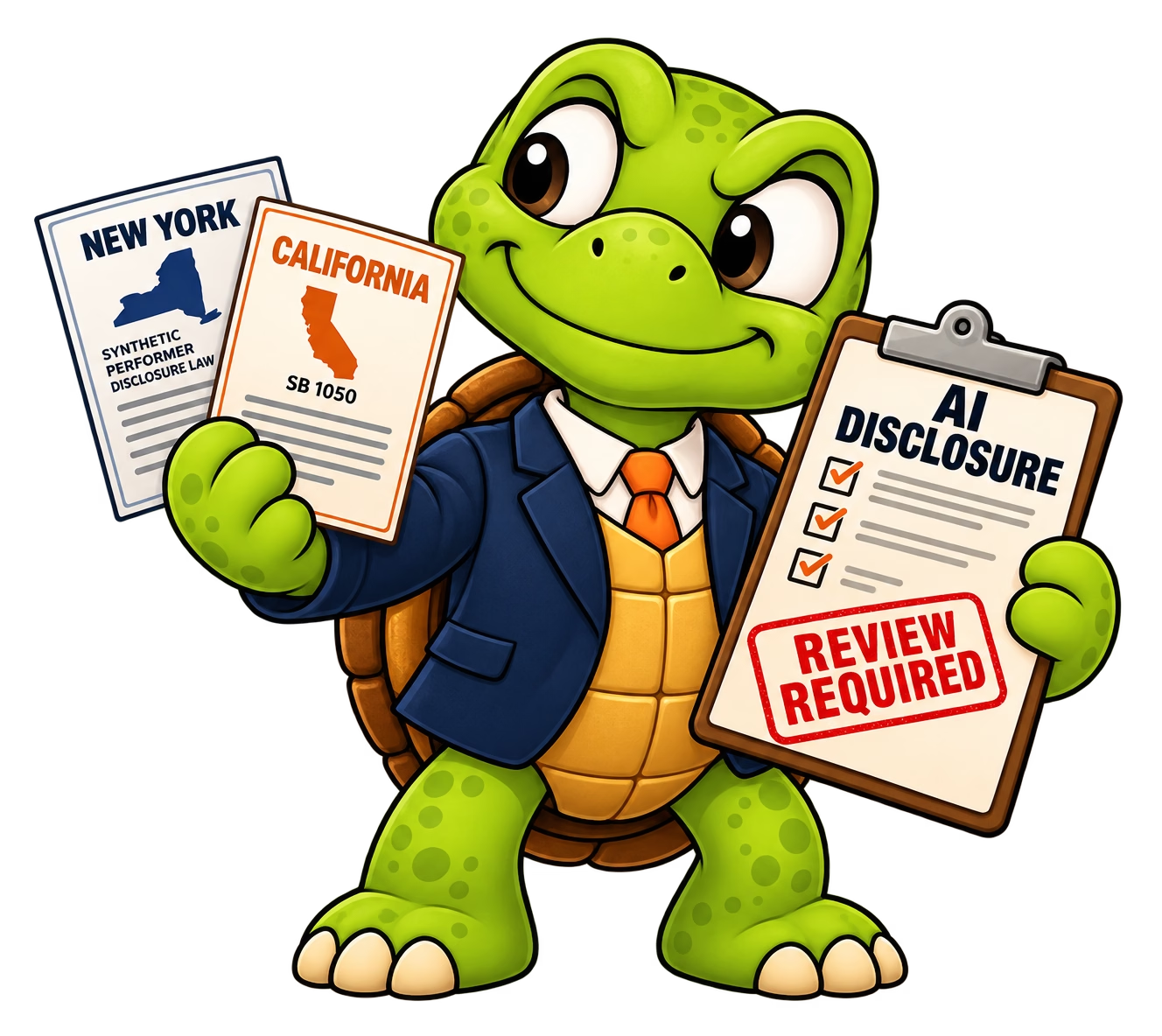
Yes. Etsy also highlights California’s SB 1050, which takes effect January 1, 2027, and may require disclosures for certain realistic AI-generated synthetic performers used in advertising. Etsy specifically mentions that listing images and videos may qualify as advertisements under the law.
California isn’t the first state to introduce this type of legislation, either. New York’s synthetic-performer disclosure law took effect on June 9, 2026, requiring disclosures when qualifying advertisements feature AI-generated synthetic human performers. California’s SB 1050 follows a similar approach, although the two laws aren’t identical. For sellers using realistic AI-generated people in their marketing, this is something worth paying attention to beyond the Etsy AI Policy 2026 release.
A synthetic performer generally involves an AI-generated representation that realistically appears to be a human performer rather than an identifiable real person. The legal obligations depend on the circumstances, so I wouldn’t assume every AI character or AI-assisted product image automatically falls under this rule.
However, sellers using realistic AI-generated people in listing photos or videos should examine the requirements carefully, particularly if their advertising falls under California’s or New York’s disclosure requirements. It’s another reminder that Etsy’s policies aren’t necessarily the only rules that apply to AI content.
FAQs About the Etsy AI Policy 2026 Notice
Does Etsy Ban All AI-Generated Images?
No. Etsy continues to permit qualifying AI-generated artwork and certain AI-edited listing images. Sellers must follow its Creativity Standards, applicable disclosure requirements, and rules against misleading product representations.
Can I Still Use Printify Mockups on Etsy?
Yes, when they meet Etsy’s POD exception. Etsy allows authorized stock-photo mockups for qualifying products featuring sellers’ original designs printed by production partners. Not every AI-generated or third-party mockup automatically qualifies.
Do I Have to Put an Unedited Photograph First on Etsy?
Not generally. The October 22 unedited-photo requirement doesn’t universally specify first-image placement. However, separate rules require certain customized listings to show a finished customized item first.
Can I Sell AI-Generated Printable Wall Art on Etsy?
Yes, when it qualifies under Etsy’s Creativity Standards. Sellers must contribute the required creative input, disclose AI use, and ensure their listing images accurately represent what buyers receive.
Are AI Crochet Patterns Allowed on Etsy?
No, if AI generated the functional instructions. Etsy prohibits AI-generated functional guides and also requires a real photograph of something actually made using the pattern.
Can I Use AI-Generated Images for an Etsy Audio Download?
Yes, as representative imagery when appropriate. Etsy expressly allows representative images, including AI-generated ones, for digital items without visual elements, provided they don’t mislead buyers.
Does the Etsy AI Policy 2026 Require a Real Photo for a Digital Spreadsheet?
Not necessarily. Etsy says visually oriented digital downloads should include previews or excerpts. Screenshots showing the spreadsheet’s actual features are a practical way to satisfy that expectation without photographing a physical product.
Can Etsy Sellers Use AI to Remove Photo Backgrounds?
Yes, on additional listing images. Etsy permits background cleanup and replacement as long as the product itself remains accurately represented. The required original photograph must remain unedited.
Can AI Edit the Color of My Etsy Product?
Only when the adjustment preserves the item’s real appearance. Correcting inaccurate lighting or color balance on an additional image is different from making the actual product appear to have a different color or material.
Will Etsy Automatically Ban Shops That Use AI Images?
No. Etsy still allows certain AI content. However, misleading listings, prohibited bot-generated listings, and repeated policy violations can result in enforcement, potentially including shop removal.
When Must Sellers Update Their Existing Listing Photos According to the Etsy AI Policy 2026 Release?
Etsy says noncompliant existing listings must be updated, but its October 22 announcement doesn’t specify an exact grace period. Sellers shouldn’t assume they can wait until after the holidays.
Can Sellers Appeal an Etsy AI Policy 2026 Violation?
Yes. Etsy says sellers can appeal removed listings through the Policy violations page in Shop Manager.
What Should Etsy Sellers Do Right Now?
My advice is to review your listings, understand which rules apply to your products, and correct genuine compliance problems without making expensive changes based on rumors.
What Should POD, Digital, and Handmade Sellers Check First?
For POD sellers, I’d start by checking the source of your mockups and confirming that you’re using images you’re authorized to use. Don’t start ordering hundreds of product samples because someone on social media told you that every listing now requires one.
For digital sellers, I’d make sure your previews accurately represent the files buyers actually receive. And if you’re selling crochet patterns, recipes, knitting instructions, or other functional guides, pay particular attention to how those instructions were created.
Handmade and vintage sellers should review their product photographs and make sure they have the original images Etsy requires. I’d also look for edited photographs that might hide damage or make products look noticeably different from reality.
And for everyone using AI, make sure the appropriate disclosures are in place.
Is the Etsy AI Policy 2026 Release a Step in the Right Direction?
Personally, I don’t think asking sellers to represent their products honestly is unreasonable. I’ve seen enough misleading mockups and unrealistic AI-generated images to understand why buyers are concerned. But I also think Etsy needs to recognize how many legitimate sellers rely on digital design tools, photo editing, and production partners to run their businesses. Technology isn’t going backward, and pretending AI isn’t part of modern creative work won’t solve anything.
The challenge is distinguishing sellers who use these tools responsibly from sellers who use them to deceive people. That requires clear rules, reasonable enforcement, and meaningful answers when sellers encounter situations the policies don’t explain. I’ve discussed some of these broader marketplace challenges in my article about whether selling on Etsy is still worth it. These changes don’t automatically make Etsy a bad marketplace, but they do give sellers another reason to pay attention to how the platform is evolving.
For now, I wouldn’t panic. I wouldn’t make assumptions about deadlines or exemptions, either. I’d review the official policies, address what clearly needs fixing, and keep an eye on Etsy’s next moves. My advice? Don’t start deleting listings, ordering a garage full of product samples, or throwing your computer out the window just yet. Although after the day I’ve had researching all this, that last option is sounding a little tempting.
What Questions Should Etsy Answer Next?
If you have a question about how these new rules apply to your products, leave it in the comments. I’m especially interested in unusual situations Etsy hasn’t addressed clearly, because those are the questions worth investigating further. I may not have an answer for you, but I’ll definitely put it on my radar and try to find out. I’ll update this article when new information becomes available. And if there’s enough interest in a particular issue, I may give it a more detailed investigation of its own. Because if Etsy thinks one announcement is going to answer every question sellers have about AI, they are sadly mistaken, lol. I have a feeling we’re just getting started.
Want a Quick Reference to the Etsy AI Policy 2026 Rules?
I know this article covers a lot of ground, so I’ve put together a free, one-page Etsy AI Policy 2026 Quick Reference Sheet with the main rules for POD, digital, handmade, and vintage sellers. An Etsy AI Policy 2026 cheat sheet, if you will.
Want to stay ahead of Etsy’s changes? When you sign up, you’ll also get my future Etsy updates, AI tutorials, creative business tips, and occasional freebies. I’ll share what’s changing and what I think is actually worth your time.
Your information is handled according to my Privacy Policy
Enter your details above, confirm your email address, and your cheat sheet will be ready to download. You can save it, print it, and keep it handy while reviewing your listings. And if you ever decide my emails aren’t your thing, you can unsubscribe anytime.
Official references: Etsy’s October 22 AI announcement | Listing Image Requirements | Etsy’s Creativity Standards | Etsy’s Stance on AI Creations